About Urochloa mutica (Forssk.) T.Q.Nguyen
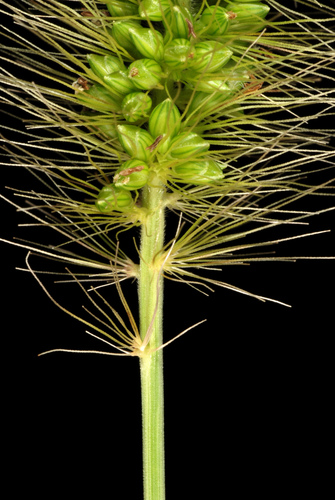
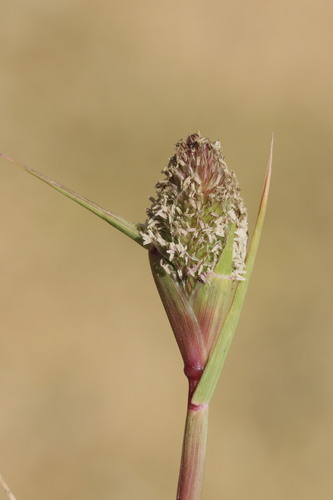
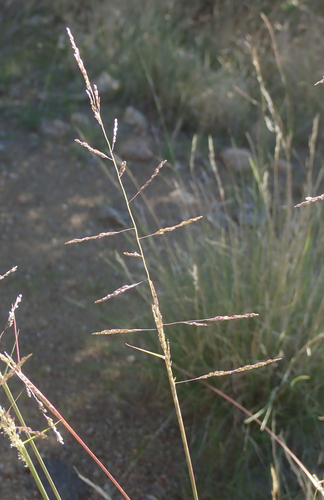
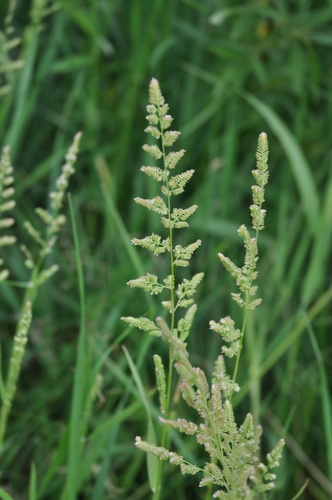
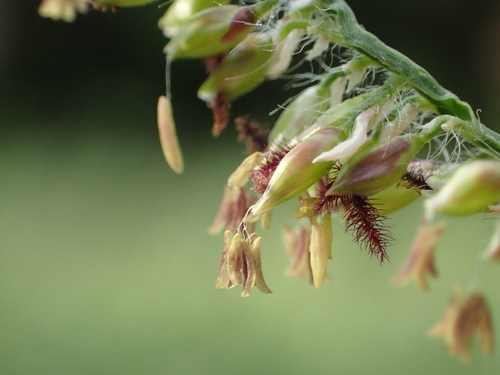
Para grass, scientifically known as Urochloa mutica (Forssk.) T.Q.Nguyen, is a vigorous, semi-prostrate perennial grass with creeping stolons that can reach up to 5 metres (16 ft) in length. Its stems have hairy nodes and leaf sheaths, while the leaf blades grow up to 2 centimetres (0.8 in) wide and 30 centimetres (12 in) long. This grass roots at its nodes, and detached plant pieces root easily when placed in moist ground. Its flower head is a loose panicle up to 30 centimetres (12 in) long with spreading branches. Paired spikelets are arranged in uneven rows, are elliptical in shape, and measure 2.5 to 5 millimetres (0.1 to 0.2 in) long. The rachis of the flower head has a purple tinge. Although many flower heads develop, only a small number of viable seeds are produced, so propagation usually occurs through vegetative methods. Para grass can be told apart from its close relative tanner grass (Brachiaria arrecta) by its paired spikelets; tanner grass produces single spikelets. Para grass is native to northern and central Africa, and parts of the Middle East. It was introduced to Central America, but has been largely replaced there by other Brachiaria species. It was also introduced into the humid, tropical regions of Australia around 1880, and has become widely naturalized in Queensland. Within a few decades after introduction, it had naturalized across most of southern Asia and many Pacific islands. It remains restricted to its preferred habitat: poorly drained, swampy land. Along with tanner grass, it is planted as a fodder grass in seasonally flooded or swampy habitats, and in ponds within pastures. However, it can block irrigation ditches and drains. When used as cattle forage, grazing animals typically keep the grass controlled, preventing it from becoming overly weedy. When it grows in other habitats, it can become noxious. It is an aggressive species that can form dense stands, and may also have allelopathic effects that prevent other plants from growing. This species may have been introduced to the Americas on slave ships, where it was used for bedding. It was present in South America by the early 1800s, and in Mexico by 1872. It was introduced to Florida by the late 1870s to be grown as fodder. It has since escaped cultivation in many areas, and now grows as a widespread weed. It is sensitive to frost, so it generally does not persist outside of warm regions. Para grass is mainly cultivated to feed livestock, as it produces high quality forage for ruminant animals.