About Urochloa brizantha (A.Rich.) R.D.Webster
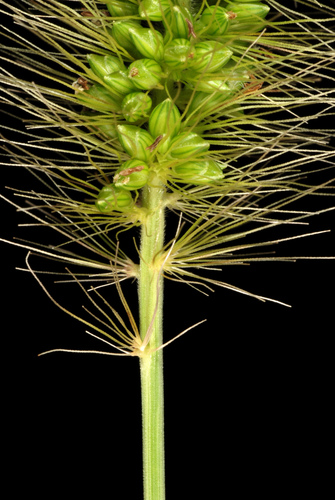
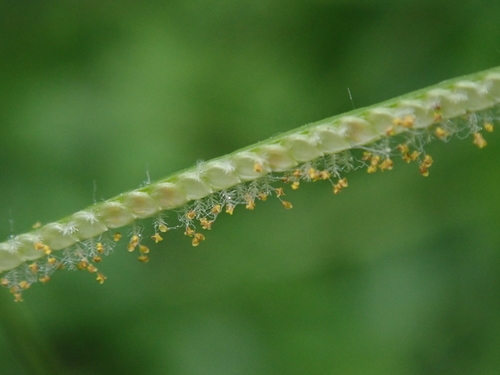
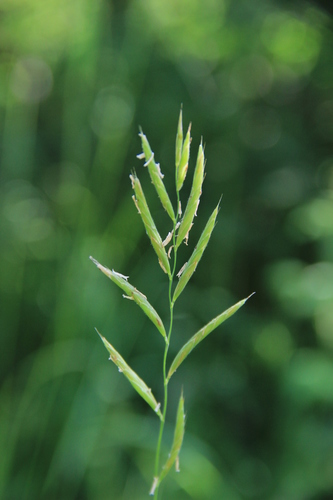
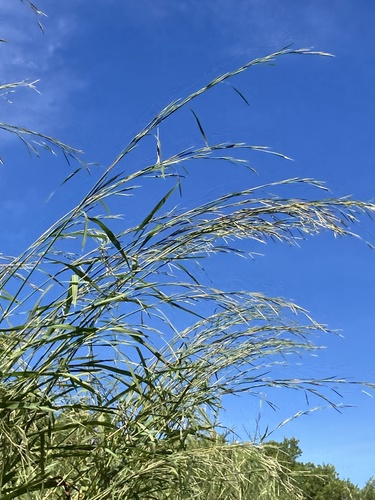
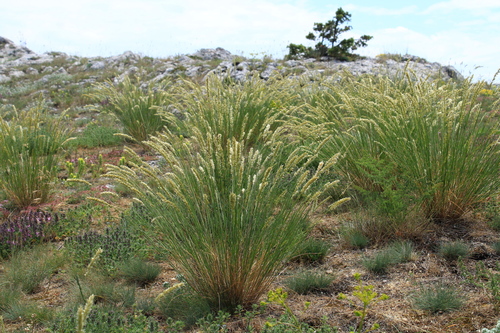
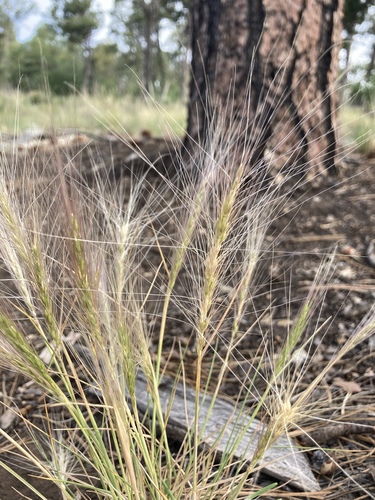
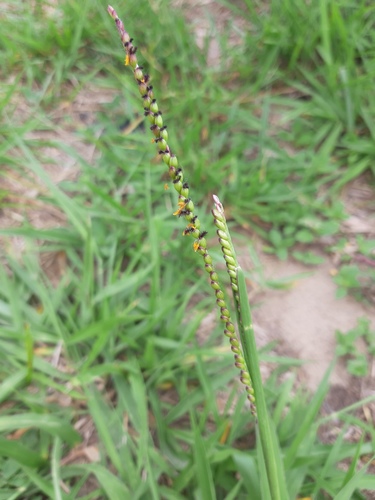
Urochloa brizantha is a rhizomatous perennial grass that grows 1 to 2 meters tall, with a root system that can reach 2 meters deep. Its green leaf blades grow 40 to 100 centimeters long and 2 centimeters wide, and are hairless or have a light covering of rough hairs. The plant produces a panicle inflorescence up to 20 centimeters long and 3 centimeters wide, split into several rolled, crescent-shaped branches. Its spikelets grow singly rather than in pairs, and are arranged closely along the crescent-shaped panicle branches. Panicle branches may have purple rachises, and spikelets may be tinged with purple. This species is native to tropical and southern Africa, and has been intentionally introduced to many other regions across the world, including South America and the Pacific. In Brazil, it is the main forage grass grown across an area larger than 70,000 km². It is adapted to grassland and woodland habitats, and is a warm-season grass that only tolerates light frost. It survives drought better than many other tropical grasses. It can grow in a wide range of soil types, but does not grow in infertile soils, and usually requires supplemental nitrogen when cultivated. It tolerates some shade, and some varieties can tolerate mild flooding. Wild animals including baboons and chimpanzees feed on this grass. Urochloa brizantha is susceptible to leaf blight caused by the fungus Rhizoctonia solani, rust caused by the fungus Uromyces setariae-italicae, and root rot caused by the bacterium Erwinia chrysanthemi. The ergot fungus Claviceps sulcata has also been recorded growing on this grass, and shield bugs in the genus Scaptocoris can damage the plants. However, the species is known for its resistance to spittlebugs like Deois flavopicta, especially in the cultivar 'Marandú'. It is also resistant to leafcutter ants from the genera Atta and Acromyrmex. Humans grow this grass primarily as feed for livestock. It is planted in grazing pastures, and can also be cut to make hay and fodder. It tolerates heavy grazing pressure, is nutritious, and is palatable to livestock. It is also used as feed for rabbits. Common cultivated varieties include 'Marandú', 'Gigante', 'Insurgente', 'La Libertad', 'Serengeti' and 'Karanga'. It is often grown alongside companion plants; common companions include other grasses such as Urochloa humidicola and Urochloa dictyoneura, plus legumes including perennial Arachis species, Stylosanthes species, Desmodium heterocarpon, Desmodium intortum, Centrosema molle, Alysicarpus vaginalis, Leucaena leucocephala, and Pueraria phaseoloides. Beyond forage use, this grass is grown as an ornamental, used for erosion control, and its grain is edible for human consumption.