About Upupa epops Linnaeus, 1758
Size and Taxonomy
The Eurasian hoopoe (Upupa epops Linnaeus, 1758) is a medium-sized bird, measuring 25–32 cm (9.8–12.6 in) in length, with a 44–48 cm (17–19 in) wingspan, and weighing between 46–89 g (1.6–3.1 oz).
Bill Structure
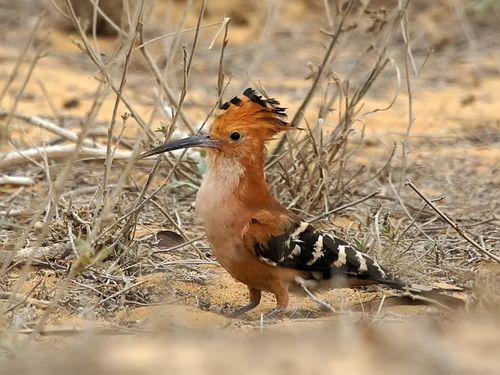
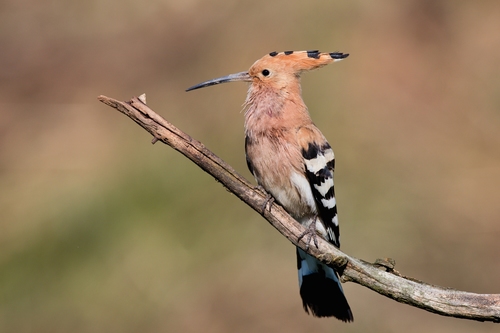
This species is highly distinctive, with a long, thin tapering bill that is black with a fawn base. Strengthened head musculature allows the bird to open its bill while probing inside soil.
Wing Structure
Eurasian hoopoes have broad, rounded wings capable of strong flight; these wings are larger in the northern migratory subspecies. This bird has a characteristic undulating flight, similar to that of a giant butterfly, which forms when the wings half-close at the end of each beat or short sequence of beats.
Moult Pattern
Adult Eurasian hoopoes may begin their moult after the breeding season and continue moulting after they have migrated for the winter.
Species Name Etymology
The species' typical call is a trisyllabic oop-oop-oop, which is likely the origin of both its English and scientific names, though two-syllable and four-syllable calls are also common. An alternative explanation for the names is that they derive from the French name for the bird, huppée, which means crested.
Call Confusion
In the Himalayas, Eurasian hoopoe calls can be confused with the calls of the Himalayan cuckoo (Cuculus saturatus), though Himalayan cuckoos typically produce four notes.
Other Vocalizations
Other calls the Eurasian hoopoo makes include rasping croaks when alarmed, and hisses. Females produce a wheezy note during courtship feeding by the male.
Geographic Range
This species is widespread across Europe, Asia, North Africa, and northern Sub-Saharan Africa.
Migration Patterns
Most birds from Europe and northern Asia migrate to the tropics for winter; birds that breed in Europe usually migrate to the Sahel belt of sub-Saharan Africa, and the species predominantly migrates at night. In contrast, African populations are sedentary year-round.
Vagrant Records
The Eurasian hoopoe has occurred as a vagrant in Alaska, with the subspecies U. e. saturata recorded there in 1975 in the Yukon Delta. Eurasian hoopoes have been known to breed north of their main European range, and in southern England during warm, dry summers that provide abundant grasshoppers and similar insects.
Population Trends
As of the early 1980s, northern European populations were reported to be declining, possibly due to climate changes.
Irish Sightings
In 2015, a record number of hoopoes was recorded in Ireland, with at least 50 birds observed in the southwest of the country. This was the highest recorded count since 1965, when 65 individuals were sighted.
Habitat Requirements
The Eurasian hoopoe has two core habitat requirements: bare or lightly vegetated ground for foraging, and vertical surfaces with cavities (such as trees, cliffs, walls, nestboxes, haystacks, and abandoned burrows) for nesting.
Habitats Occupied
These requirements can be met across a wide range of ecosystems, so the species lives in a wide variety of habitats including heathland, wooded steppes, savannas, grasslands, and forest glades.
Seasonal Movements
In some regions such as Ceylon and the Western Ghats, hoopoes make seasonal movements in response to rain.
High Altitude Records
Birds have been observed at high altitudes during migration across the Himalayas, and one individual was recorded at about 6,400 m (21,000 ft) by the first Mount Everest expedition.
Sunbathing Behaviour
In behaviour that was long mistaken for a defensive posture, hoopoes sunbathe by spreading their wings and tail low against the ground, tilting their head upward; they often fold their wings and preen partway through the sunbathing session.
Bathing Behaviour
They also enjoy taking dust and sand baths.
Diet Composition
The Eurasian hoopoe's diet is mostly made up of insects, though small reptiles, frogs, and plant matter such as seeds and berries are sometimes eaten as well.
Foraging Habits
It is a solitary forager that typically feeds on the ground. More rarely, it will feed in the air, where its strong, rounded wings let it move quickly and maneuverably while pursuing swarms of insects.
Foraging Method
Its most common foraging method is to walk across relatively open ground, pausing periodically to probe into the ground with the full length of its bill. It detects insect larvae, pupae, and mole crickets with its bill, and extracts or digs these prey out with its strong feet.
Additional Foraging Behaviours
Hoopoes will also feed on insects on the surface, probe into piles of leaves, and even use their bill to lever large stones and flake bark off trees.
Common Prey Items
Common diet items include crickets, locusts, beetles, earwigs, cicadas, ant lions, bugs, and ants.
Prey Size
Prey ranges from 10 to 150 mm (3⁄8 to 5+7⁄8 in) in length, with a preferred prey size of around 20–30 mm (3⁄4–1+1⁄8 in).
Prey Handling
Larger prey items are beaten against the ground or a preferred stone to kill the prey and remove indigestible body parts such as wings and legs.