About Upucerthia saturatior Scott & Wed, 1900
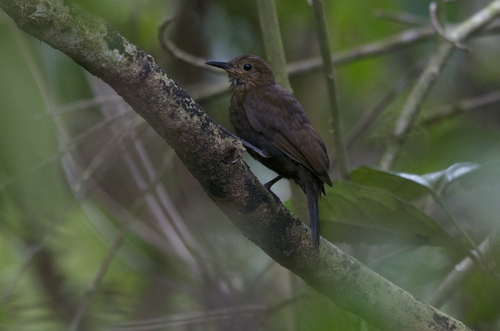
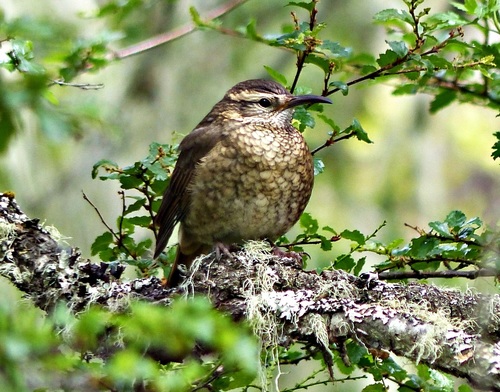
The Patagonian forest earthcreeper, with the scientific name Upucerthia saturatior Scott & Wed, 1900, measures 20 to 22 cm (7.9 to 8.7 in) in length. It is a large earthcreeper with a medium-length, moderately decurved bill. The plumage of males and females is identical. Adults have a whitish supercilium, while the rest of their face is a mix of grayish white and dark grayish brown. Their crown is dull dark grayish brown with faint mottling. Their nape, back, rump, and uppertail coverts are dark brownish gray with an olive tinge. The central feathers of their tail are dusky brown, and all other tail feathers are blackish brown. Their wings are grayish brown, and the flight feathers have dull rufous bases. Their chin is whitish, their throat is whitish with thin dark bars, their breast is dark grayish with a brown scalloped pattern, their belly is grayish, their flanks are grayish brown, and their undertail coverts are dull gray-brown. Their iris is dark brown, their bill is blackish, and their legs and feet are dark brown. Juveniles look similar to adults but have an even shorter bill. The Patagonian forest earthcreeper is distributed in central Chile between Concepción and Valdivia provinces, and in western Argentina between Neuquén and Chubut provinces. A small number of scattered records exist of the species as far north in Chile as Santiago. Only the Argentine population of this species occurs in Patagonia. It inhabits forest edges, including edges of forest clearings, and is usually found near bodies of water. It favors Nothofagus forest, but also lives in other forest types. It is thought to occupy dry deciduous forest and matorral near the Chilean coast during the austral winter. Its elevational range spans from 250 to 1,800 m (800 to 5,900 ft).