About Upucerthia ruficaudus (Meyen, 1834)
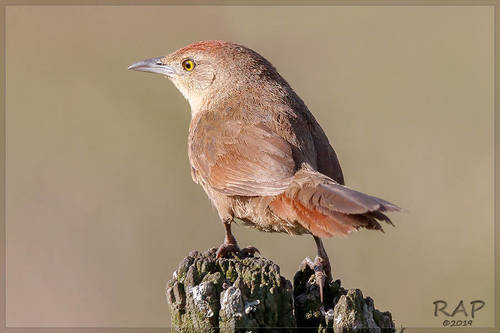
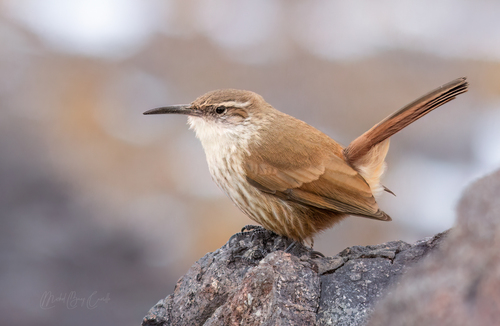
The straight-billed earthcreeper (scientific name Upucerthia ruficaudus, first described by Meyen in 1834) is 16 to 19 cm (6.3 to 7.5 in) long and weighs 28 to 41 g (0.99 to 1.4 oz). It is a medium-sized earthcreeper with a long bill that is only very slightly curved downward. The species shows no visible difference between males and females. Adults of the nominate subspecies U. r. ruficaudus have a dull brownish face with scattered paler markings, a narrow whitish stripe above the eye (supercilium), a black stripe running through the eye, and whitish cheeks. In the northern part of the nominate subspecies' range, the crown is brown with faint darker mottling, the back and rump are rufescent brown, and the uppertail coverts are dark rufescent. In the southern part of the range, the nominate's upperparts are darker and less reddish. The central pair of tail feathers have a rufous base that blends into blackish tips, while the outermost pair are mostly rufous. The tail feathers between these two pairs have mostly blackish-brown inner webs and dark rufous outer webs. The nominate's throat is whitish, its breast is whitish with faint dull brownish streaks, its flanks and belly are pale rufescent brown with some whitish streaks on the upper belly, and its undertail coverts are tawny. Its iris is brown, its bill is black or blackish brown with a whitish horn-colored base to the lower mandible, and its legs and feet are black or blackish brown. Juveniles have an overall rufous tinge, with pale edges on their crown and back feathers. Subspecies U. r. montanus has a whiter throat and breast than the nominate subspecies, with more conspicuous streaks on its sides and flanks. Subspecies U. r. famatinae has a slightly darker back than the nominate, a whiter breast, and darker flanks and undertail coverts. The straight-billed earthcreeper is native to the southern Andes, with its three subspecies occupying distinct ranges from north to south. The most northerly subspecies, O. r. montanus, is found from the Department of Arequipa in southern Peru into northern Chile as far as the Tarapacá Region, and extends east and south through Bolivia from La Paz Department into northern Argentina as far south as Catamarca Province. The nominate subspecies U. r. ruficaudus occurs in western Argentina between San Juan and extreme northern Santa Cruz provinces, and in adjoining Chile as far south as the Santiago Metropolitan Region. Subspecies U. r. famatinae is restricted to the Sierra de Famatina in La Rioja Province, northwestern Argentina. This bird inhabits arid scrublands with bunchgrass and scattered bushes, and favors rocky hillsides, rocky outcrops, and ravines. It mostly occurs at elevations between 2,300 and 4,300 m (7,500 and 14,100 ft), though it is common as low as 1,800 m (5,900 ft) and occurs locally at elevations as low as 1,300 m (4,300 ft).