About Upucerthia dumetaria I.Geoffroy Saint-Hilaire, 1832
Scientific name: Upucerthia dumetaria I. Geoffroy Saint-Hilaire, 1832
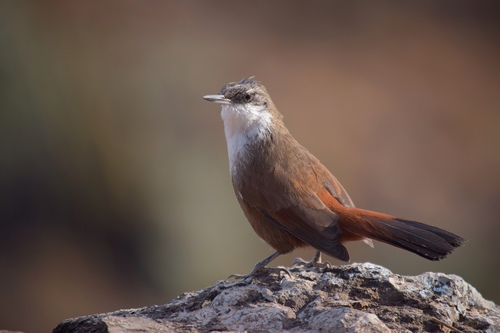
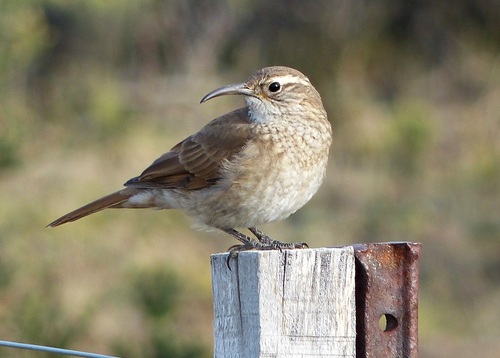
Description: The scale-throated earthcreeper measures 20 to 22 cm (7.9 to 8.7 in) in length and weighs 37 to 55.5 g (1.3 to 2.0 oz). It is a large earthcreeper with a long, strongly decurved bill. The plumage of males and females is identical. Adults of the nominate subspecies have a whitish supercilium, while the rest of their face is patterned with grayish white and dark grayish brown. Their crown is dull dark grayish brown with faint mottling. Their nape, back, rump, and uppertail coverts are a uniform dull brownish gray. The central feathers of their tail are dull grayish brown, and the remaining tail feathers are blackish brown with dull rufous tips; the area of rufous on these feathers increases from the inner to the outer feathers. Their wings are grayish brown with paler edges, and the flight feathers have dull rufous bases. Their chin is whitish, their throat is whitish with thin dark bars, their breast is dark grayish brown with a black scalloped pattern, their belly is whitish, their flanks are grayish brown, and their undertail coverts are dull gray-brown. Their iris is dark brown, their bill is blackish, and their legs and feet are dark brown. Juveniles have fine streaks on the forehead and back, and more extensive scalloping on the underparts compared to adults. Subspecies U. d. hypoleuca is similar to the nominate subspecies, but has more rufous coloration on the upperparts and more buffy coloration on the underparts. U. d. peruana is similar to U. d. hypoleuca, but has a longer bill, is slightly lighter in color, and has less rufous in its wings.
Distribution and habitat: The nominate subspecies of the scale-throated earthcreeper is the southernmost occurring of the three subspecies. It is found in far southern Chile, and occurs throughout Argentina at different times of the year. U. d. hypoleuca is found in western Bolivia, central Chile, and western Argentina. U. d. peruana is only known from two specimens collected in the 1950s in far southeastern Peru's Department of Puno. The species inhabits puna grassland and arid scrublands in both lowland areas and the Andes. It favors rocky grassland, and also occurs on shrubby slopes and shrub-steppe broken by ravines and rock outcrops. In elevation, the species ranges as high as 4,000 m (13,000 ft).