About Umbilicus rupestris (Salisb.) Dandy
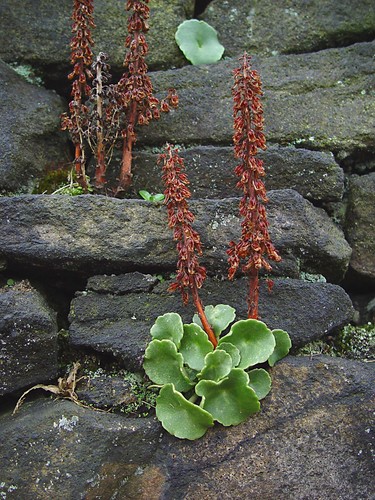
Umbilicus rupestris, commonly called wall pennywort or navelwort, grows to an average height of 25 centimetres (9.8 inches). Its pale spikes of bell-shaped, greenish-pink flowers first emerge in May, and its green fruits ripen throughout the summer. This plant is native to southern and western Europe, where it most often grows on shady walls or in damp rock crevices that have little other plant growth — the common name "wall pennywort" comes from this typical growing location. In these sites, its succulent leaves grow in rosettes. It is not currently considered a threatened species. Umbilicus rupestris is not the same "pennywort" used in Asian medicine; that species is the unrelated Asiatic pennywort, Centella asiatica. Navelwort is often assumed to be the "kidneywort" that Nicholas Culpeper referred to in his book The English Physician, though the plant he referenced may actually be the unrelated Anemone hepatica. Culpeper classified herbs using astrology rather than scientific method, so he is not a reliable source. He did make a number of claims about the medicinal effects of this plant: drinking the juice or distilled water is effective for all inflammations and unnatural heats, to cool a faint overheated stomach, hot liver, or overheated bowels. When applied externally, the herb, its juice, or distilled water, heals pimples, St. Anthony's fire, and other external heated conditions. The juice or water also helps heal sore kidneys damaged or irritated by kidney stones, or ulcerated kidney tissue; it also promotes urination, is useful for treating dropsy, and helps break up kidney stones. When used as a bath or made into an ointment, it cools painful hemorrhoids. It is equally said to be effective at easing pain from gout and sciatica, and helps with lumps or knots in the neck or throat called the king's evil. It heals kibes and chilblains when they are bathed with the juice or anointed with an ointment made from the plant, with a bit of the leaf skin applied over them. It is also used on fresh wounds to stop bleeding and speed healing.