About Umbellularia californica (Hook. & Arn.) Nutt.
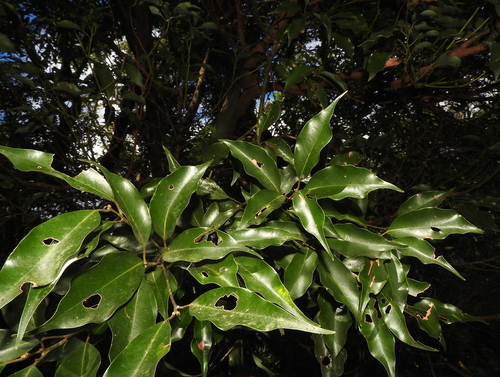
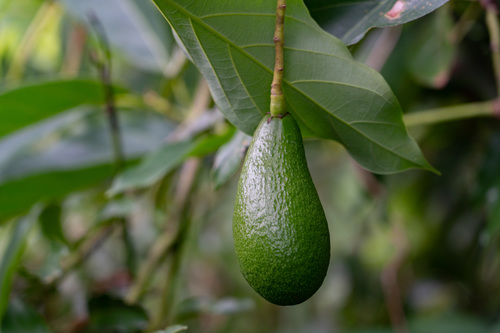
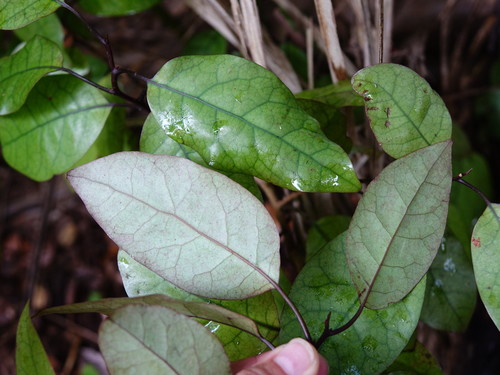
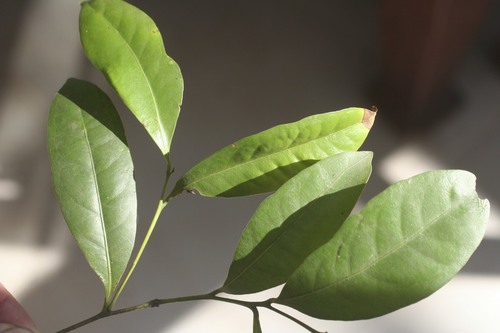
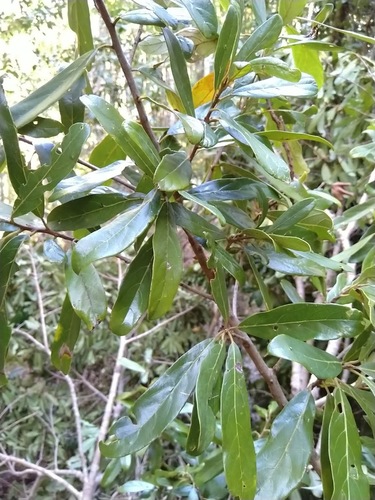
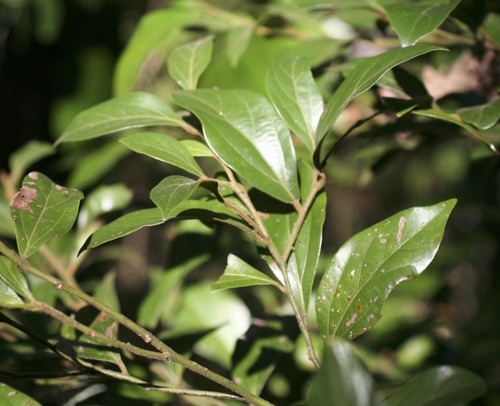
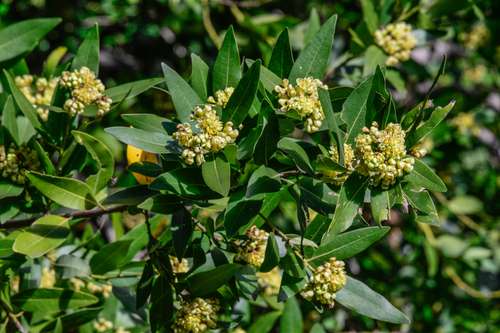
Umbellularia californica (Hook. & Arn.) Nutt. is an evergreen tree that grows up to 30 metres (98 feet) tall, with a trunk reaching up to 90 centimetres (35 inches) in diameter. As of 1997, the largest recorded specimen grows in Mendocino County, California, measuring 33 m (108 ft) tall with a 36 m (119 ft) spread. When young, its thin bark is smooth and gray-brown; as the tree matures, the bark becomes reddish brown and scaly. Its fragrant leaves are smooth-edged and lance-shaped, 3–15 cm (1+1⁄4–6 in) long and roughly one-third as wide. The leaves are similar in appearance to the related bay laurel, though they are usually narrower and lack the crinkled margin that bay laurel has. The leaves are green, with a lighter color on the underside. When bruised, both the bark and leaves give off a pungent scent similar to camphor, which comes from a chemical called umbellulone. Its flowers are small, yellow or yellowish-green, and grow in small umbels – a trait that gives the genus its scientific name Umbellularia, meaning "little umbel". Unlike other "bay laurels" of the genus Laurus, Umbellularia produces perfect flowers, which contain both male and female parts in a single flower. The fruit of this species, commonly called "California bay nut", is a round green berry 2–2.5 cm long and 2 cm wide, with light yellow spotting. It ripens to a purple color. Under the thin, leathery outer skin, the fruit has an oily fleshy layer covering a single hard, thin-shelled pit, giving it the appearance of a miniature avocado. Umbellularia is related to the avocado genus Persea, both belonging to the family Lauraceae. In the tree's native range, the fruit ripens around October to November. The oldest known living laurel of this species is the Jepson Laurel, named after Willis Linn Jepson, which grows in San Mateo County on land owned by the San Francisco Water Department, which cares for the tree. This species is native to southwest Oregon and California, ranging south to San Diego County, and also grows in the western foothills of the Sierra Nevada mountains. It occurs at elevations from sea level up to 1,600 m (5,200 ft). It has been introduced as an exotic species to British Columbia, Washington, and northern Oregon. It most often grows in redwood forests, California mixed woods, yellow pine forest, and oak woodlands. California bay laurel grows in coastal oak woodlands and in northern California areas where moisture is sufficient, usually in or near riparian zones. The species is very shade tolerant, and it only grows as a shrub in extremely dry and hot habitats. During the Miocene epoch, oak-laurel forests covered Central and Southern California. Typical tree species in these forests included oaks ancestral to modern California oaks, and a group of laurel family trees including Nectandra, Ocotea, Persea, and Umbellularia. Today, Umbellularia californica is the only remaining native laurel family species in California. In terms of ecology, these trees resprout from their root systems after being killed by fire, and deer feed on the fresh new sprouts. This species is a host for Phytophthora ramorum, the pathogen that causes the plant disease sudden oak death. It plays an important role in the spread of this disease because it is one of only two tree species (the other being tanoak) that the pathogen readily produces spores on.