About Ulmus thomasii Sarg.
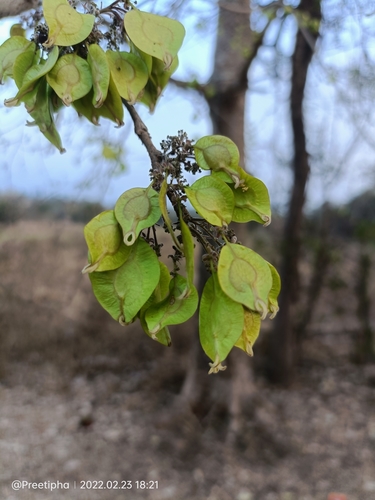
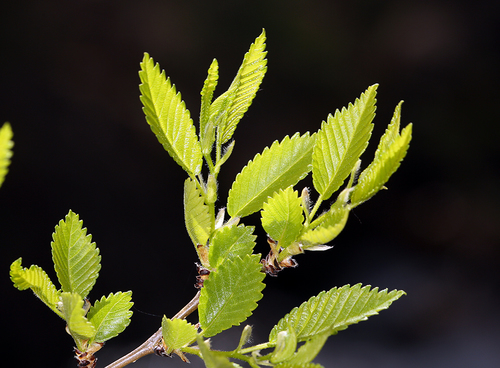
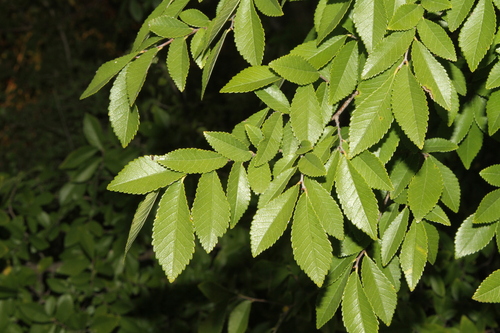
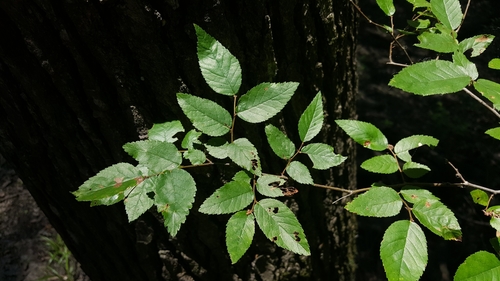
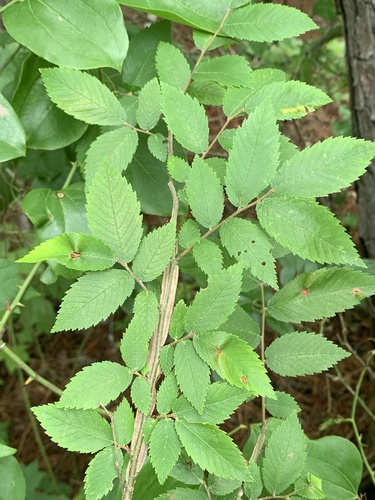
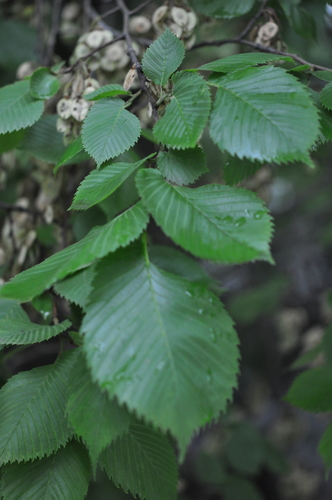
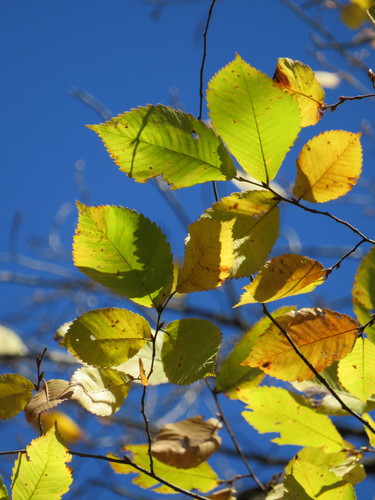
Ulmus thomasii Sarg., commonly called rock elm or cork elm, grows as a tree reaching 15–30 m (50–100 ft) in height, and may live up to 300 years. When grown in a forest, its crown is cylindrical, upright, and formed of short branches, and it is narrower than the crowns of most other elm species. Rock elm is also unusual among North American elms because it is often monopodial. Its bark is grey-brown, deeply furrowed into scaly, flattened ridges. Many older branches develop 3–4 irregular thick corky wings; this characteristic is why the species is sometimes called cork elm. The leaves are 5–10 cm (2–4 in) long and 2–5 cm (3⁄4–2 in) wide, shaped oval to obovate with a round, symmetrical base and acuminate apex. The upper leaf surface is shiny dark green, turning bright yellow in autumn, while the underside is covered in fine hairs. The flowers are perfect, apetalous, and wind-pollinated; they are red-green, grow in racemes up to 40 mm (2 in) long, and appear two weeks before leaves emerge, between March and May depending on the tree's location. The fruit is a broad ovate samara 13–25 mm (1⁄2–31⁄32 in) long, covered in fine hair, notched at the tip. It matures in May or June, forming drooping clusters at the bases of leaves. Although U. thomasii is protandrous, it still experiences high levels of self-pollination. U. thomasii is moderately shade-tolerant. Its preferred habitat is moist but well-drained sandy loam, loam, or silt loam soil growing alongside other hardwoods, but it also grows on dry uplands, especially on rocky ridges and limestone bluffs. There are no known cultivars of U. thomasii, and it is no longer available commercially. It was listed in some United States nursery catalogues in the early 20th century, and has been planted as a street tree in Cheyenne, Wyoming, where when planted in tight lines it retains a monopodial habit that recalls the Jersey elm. The species is occasionally grown beyond its native range as a specimen tree in botanical gardens and arboreta, including in northwestern Europe, but it is not commonly cultivated in northern Europe, as it is not suited to the region's more temperate, maritime climate. It was propagated and sold in the UK by Hillier & Sons nursery, Winchester, Hampshire, from 1965 to 1977, during which period 49 trees were sold. U. thomasii was crossed experimentally with Japanese elm (U. davidiana var. japonica) at the Arnold Arboretum in Massachusetts, but no clones were ever released for commercial sale. All seedlings produced from crossings with Siberian elm (U. pumila) at the Lake States Forestry Experimental Station in the 1950s died, a clear example of hybrid lethality. The wood of rock elm is the hardest and heaviest of all elm wood, and when taken from forest-grown trees it is comparatively free of knots and other defects. It is also very strong and can take a high polish, so it was once in great demand across America and Europe for a wide range of uses, most notably boatbuilding, furniture, agricultural tools, and musical instruments. Much of the wood's strength comes from its tight grain, which forms because the tree grows very slowly: the trunk typically increases in diameter by less than 2 mm (3⁄32 in) per year. Over 250 annual growth rings were once counted in a 24 cm (9+1⁄2 in) square log being sawn for gunwales at an English boatyard, and a tree grown at Kew Gardens, London, reached only 12 m (39 ft) in height over 50 years.