About Ulmus pumila L.
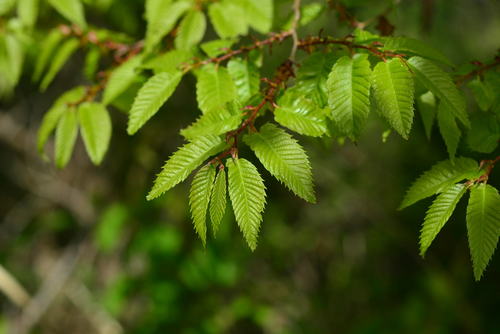
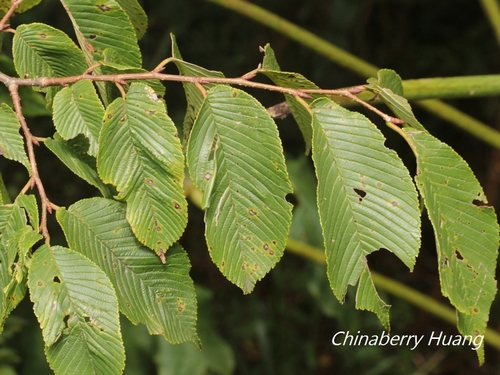
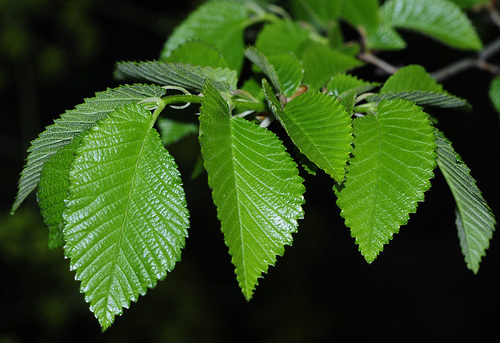
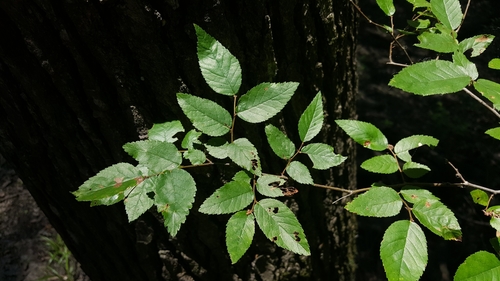
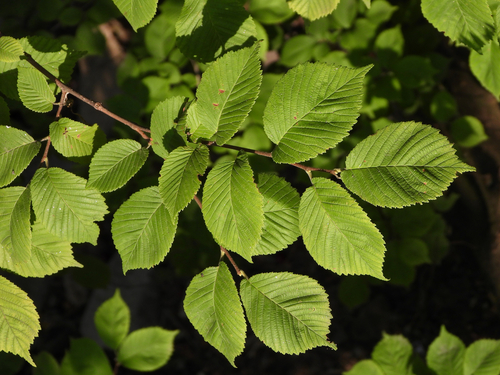
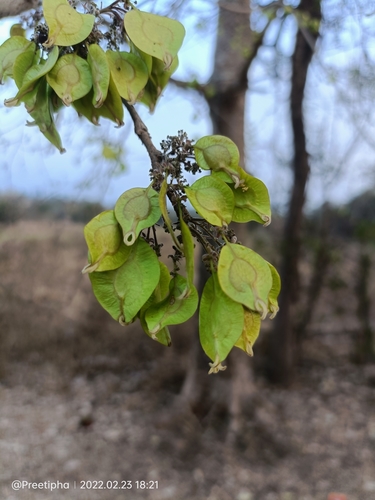
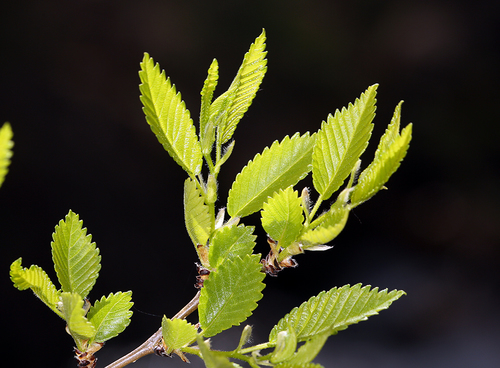
Ulmus pumila L., commonly called Siberian elm, is usually a small to medium-sized, often bushy deciduous tree. It grows to 25 m (82 ft) tall, reaching 1 m (3 ft 3 in) in diameter at breast height. Its bark is dark gray with irregular longitudinal fissures. Yellowish gray branchlets are glabrous or pubescent, unwinged, lack a corky layer, and bear scattered lenticels. Winter buds are dark brown to red-brown, shaped globose to ovoid. Petioles measure 4–10 millimetres (1⁄4–1⁄2 inch) and are pubescent; leaf blades range from elliptic-ovate to elliptic-lanceolate, sized 2–8 by 1.2–3.5 centimetres (3⁄4 in–3+1⁄8 in × 1⁄2 in–1+3⁄8 in), and change color from dark green to yellow in autumn. The species produces perfect, apetalous, wind-pollinated flowers that bloom for one week in early spring before leaves emerge, growing in tight fascicles (bundles) on the previous year's branchlets. Flowers that emerge as early as February are often damaged by frost, which led to the species being dropped from the Dutch elm breeding programme. Each flower is around 3 mm (1⁄8 in) across, with a green calyx of four or five lobes, four to eight stamens with brownish-red anthers, and a green pistil with a two-lobed style. Unlike most elms, the Siberian elm can successfully self-pollinate. Its wind-dispersed samarae are whitish tan, shaped orbicular to rarely broadly obovate or elliptical, measuring 1 cm–2 cm × 1 cm–1.5 cm (3⁄8 in–3⁄4 in × 3⁄8 in–5⁄8 in), and are glabrous except for pubescence on the stigmatic surface. Samara stalks measure 1–2 mm (5⁄128–5⁄64 in), and the perianth remains persistent. The seed sits at the center of the samara, or occasionally slightly toward the apex, but does not reach the apical notch. Flowering and fruiting occur from March to May. The ploidy of this species is 2n = 28. Siberian elm suckers readily from its roots. The tree is short-lived in temperate climates, rarely living beyond 60 years of age, but may live 100 to 150 years in its native environment. A giant specimen growing 45 km (28 mi) southeast of Khanbogt in the south Gobi, with a girth of 5.55 m (18 ft 3 in) measured in 2009, may exceed 250 years, based on average annual ring widths of other local U. pumila. This tree is native to Central Asia, eastern Siberia, the Russian Far East, Mongolia, Tibet, northern China, northern Kashmir (India), and Korea. It is the last tree species found in semidesert regions of Central Asia. U. pumila was introduced to Spain as an ornamental, most likely during the reign of Philip II (1556–1598), and was introduced to Italy from the 1930s onward. In these two countries, it has naturally hybridized with field elm (U. minor). In Italy, it was widely used in viniculture, notably in the Po River Valley, to support grape vines until the 1950s, when mechanization demands made it unsuitable for this use. In 1902, Berlin's Späth nursery supplied three U. pumila specimens to the Royal Botanic Garden Edinburgh (RBGE), alongside specimens of the narrow-leaved U. pumila cultivar 'Pinnato-ramosa'. One specimen was planted at RBGE; the two unplanted specimens may still survive in Edinburgh, as the garden historically distributed trees throughout the city. Kew Gardens obtained U. pumila specimens from the Arnold Arboretum in 1908, and received specimens labeled U. pekinensis via Veitch Nurseries in 1910, collected by William Purdom in northern China. A specimen obtained from Späth and planted in 1914 stood in the Ryston Hall arboretum, Norfolk, in the early 20th century. Hillier & Sons nursery of Winchester, Hampshire, propagated and marketed U. pumila from 1962 to 1977, selling over 500 specimens in this period. More recently in Great Britain, U. pumila is grown almost exclusively as a bonsai subject, and mature specimens are largely restricted to arboreta. In the UK, recorded TROBI Champions grow at Thorp Perrow Arboretum, Yorkshire, measuring 19 m (62 ft 4 in) × 70 cm (2 ft 4 in) in 2004, and at St Ann's Well Gardens, Hove, Sussex measuring 20 m (65 ft 7 in) × 60 cm (2 ft 0 in) in 2009. U. pumila is recorded as being introduced to the US in 1905 by Prof. John George Jack, and later by Frank Nicholas Meyer, though entries for 'Siberian elm' appear in some 19th-century US nursery catalogues. The tree was cultivated at the United States Department of Agriculture (USDA) Experimental Station at Mandan, North Dakota, where it grew well. It was subsequently selected by the USDA for planting in shelter belts across the prairies after the Dustbowl disasters, where its rapid growth and tolerance for drought and cold initially made it very successful. However, the species later proved susceptible to numerous diseases. In 1997, the USDA Plant Materials Center initiated attempts to find a more suitable cultivar, establishing experimental plantations at Akron, Colorado, and Sidney, Nebraska. Study no. 201041K was scheduled to conclude in 2020. The US National Champion, measuring 33.5 m (109 ft 11 in) high in 2011, grows in Berrien County, Michigan. Siberian elm was also introduced to Canada; a notable planting is a 1 km avenue of around 130 U. pumila planted in the mid-20th century, spanning nine blocks of East 6th Avenue, Vancouver, recorded as still standing in 2025. U. pumila seeds lose viability rapidly after maturity unless placed in suitable germination conditions, or dried and stored at low temperatures. The species requires high sunlight and is not shade tolerant; it grows rapidly when it receives adequate light. It is also fairly intolerant of wet ground conditions, growing better on well-drained soils. While it is highly resistant to drought and severe cold, and can grow on poor soils, its short dormancy period, with early spring flowering followed by continuous growth until the first autumn frosts, makes it vulnerable to frost damage. As an ornamental, U. pumila is considered a very poor tree: it tends to be short-lived, has brittle wood, and has a poor crown shape. It has still seen some popularity due to its rapid growth and shade provision. It has been described as "one of the world's worst... ornamental trees that does not deserve to be planted anywhere". Even so, during the 1950s in the US it was widely promoted as a fast-growing hedging alternative to privet, and as a result is now commonly found in nearly all US states. Unripe seeds of U. pumila have long been eaten by peoples of Manchuria. During the Great Chinese Famine, these seeds also became one of the most important food sources in the Harbin region. Local people also gathered the tree's leaves, damaging the trees enough that authorities issued a prohibition order that was largely ignored. Raw leaves are not very palatable, but when stewed and prepared with kaoliang or foxtail millet they make a better-tasting, more filling meal.