About Ulmus parvifolia Jacq.
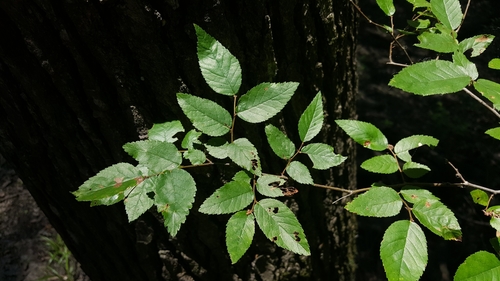
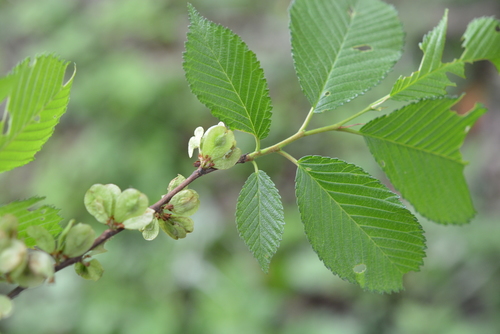
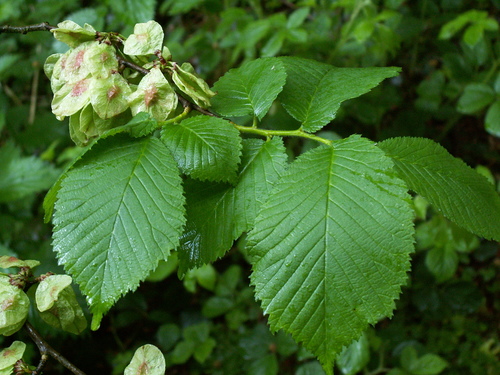
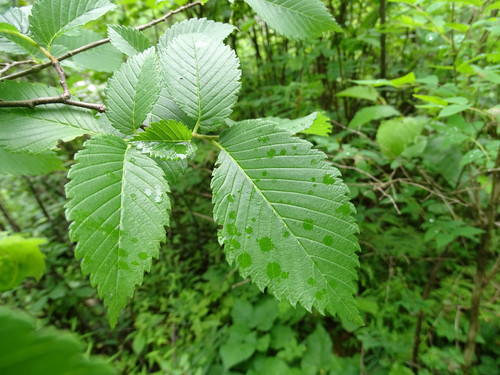
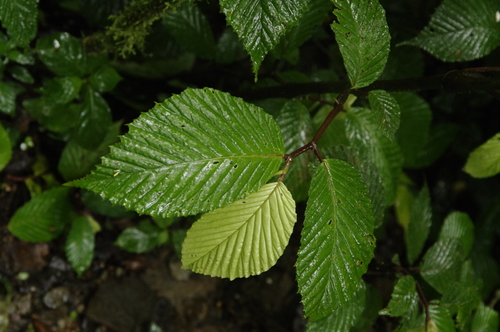
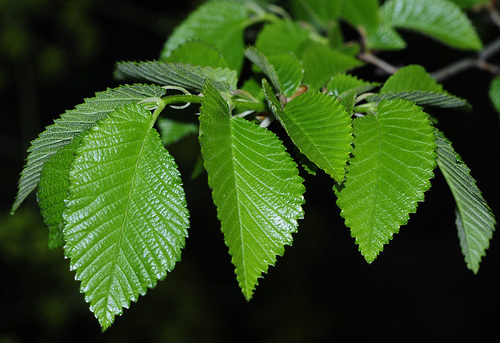
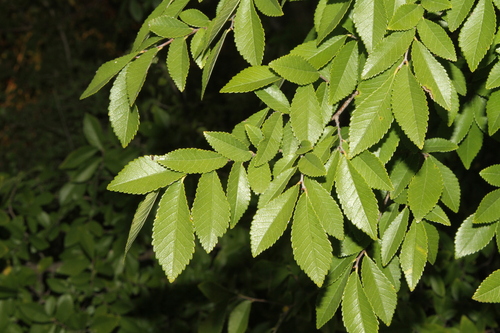
Ulmus parvifolia Jacq. is a small to medium deciduous or semideciduous tree, rarely semievergreen. It grows 10–18 m (33–59 ft) tall and 15–20 m (49–66 ft) wide, with a slender trunk and crown. Its leaves are leathery, lustrous green, single-toothed, and small, measuring 2–5 cm long by 1–3 cm broad. In Europe and North America, the leaves are often retained as late as December, and even January in some cases. In some years, the leaves develop a purplish-red autumn color. The species produces small, inconspicuous apetalous, wind-pollinated perfect flowers in early autumn. Its fruit is an elliptical to ovate-elliptical samara 10–13 mm long by 6–8 mm broad. The samara is mostly glabrous, with its seed located at the center or toward the apex, and borne on a 1–3 mm long stalk; it matures rapidly and disperses by late autumn. The trunk has attractive flaking bark mottled in shades of grey with tan and red tones, which gives the species its other common name, lacebark elm. However, scarring from major branch loss can lead to large canker-like wounds on the trunk. The ploidy of Ulmus parvifolia is 2n = 28. Many nursery workers and foresters mistakenly call Ulmus pumila, the Siberian elm, "Chinese elm". Siberian elm is a rapidly growing, disease-ridden, relatively short-lived species with weak wood. This misidentification has given the true Chinese elm (Ulmus parvifolia) an undeserved bad reputation, though the two are distinct species. Among other obvious differences, Siberian elm develops deeply ridged and furrowed bark with age that has a very rough greyish-black appearance, while true Chinese elm has smooth bark that becomes flaky and blotchy, exposing distinctive light-colored mottling (the source of the lacebark elm common name). Another clear difference is that Siberian elm releases seed in spring, while Chinese elm releases seed in autumn. The Chinese elm is a hardy landscape tree, tough enough for use in harsh planting sites including parking lots, small street-side planters, plazas, and patios. It is arguably the most widespread elm species, now found on all continents except Antarctica. It was introduced to Europe as an ornamental at the end of the 18th century, and can now be found in many botanical gardens and arboretums across the region. It was introduced to the United Kingdom in 1794 by James Main, who collected specimens in China for Gilbert Slater of Low Layton, Essex. It was also introduced to the United States in 1794; before cold-hardy forms were introduced in the 1990s, it was mainly planted in southern U.S. states and California. In recent years, it has become very popular as a replacement for American elms killed by Dutch elm disease. The tree was distributed in Victoria, Australia starting in 1857, and was marketed by Searl's Garden Emporium in Sydney at the beginning of the 20th century. In 1902, Späth supplied three Ulmus parvifolia specimens to the Royal Botanic Garden Edinburgh. In New Zealand, the species has been found to be particularly well-suited for windswept coastal locations. It is commonly planted as an ornamental in Japan, most notably around Osaka Castle. Ulmus parvifolia is one of the most cold-hardy species native to China. Artificial freezing tests conducted at the Morton Arboretum found its LT50 (the temperature at which 50% of plant tissues die) to be −34 °C (−29 °F).