About Ulex europaeus L.
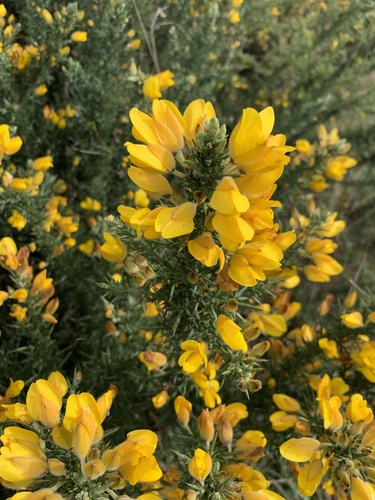
Ulex europaeus L. is an evergreen shrub that grows up to 4.5 metres (10 ft) tall. Its young stems are green, while its shoots and leaves are modified into green spines 1–3 centimetres (1⁄2–1+1⁄4 in) long. For the first few months after germination, young seedlings produce normal trifoliate leaves that resemble small clover leaves.
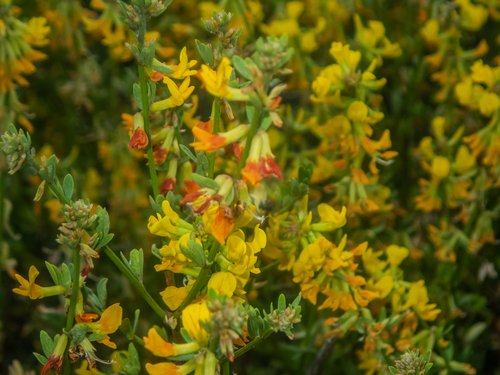
Its solitary yellow flowers are 1–2 cm (1⁄2–3⁄4 in) long, with the characteristic pea-flower structure of the Fabaceae family. Flowers are produced throughout the year, with the main flowering period occurring over a long span in spring, and they carry a coconut scent. The fruit is a dark purplish-brown legume pod 2 cm (3⁄4 in) long, which is partly enclosed by the pale brown leftover remnants of the flower. The pod holds 2–3 small, blackish, shiny, hard seeds, which are ejected when the pod splits open during hot weather. Seeds can remain viable for up to 30 years.
Like many gorse species, Ulex europaeus is often a fire-climax plant: it catches fire easily, but regrows from its roots after fire, and its seeds are adapted to germinate after being scorched by fire. It grows a tap root alongside lateral and adventitious roots. An extremely tough and hardy plant, it can survive temperatures as low as −20 °C (−4 °F), and has a maximum lifespan of around thirty years.
Like other legumes, it fixes nitrogen into soil. In cultivation, it is used for hedging, marking boundary lines, and as groundcover in appropriate sunny, open locations. Known cultivars include the dwarf form 'Strictus' (Irish gorse), and the double-flowered, non-fruiting cultivar 'Flore Pleno', which has received the Royal Horticultural Society's Award of Garden Merit. In past use, bruised gorse was fed to horses and other livestock in some areas. Its fragrant petals have a number of culinary uses.
A lectin extracted from the seeds of this species binds specifically to H substance, which is absent in the hh antigen system on human red blood cells, and this extraction is the standard method for identifying H substance. The vast majority of humans express H substance, which forms the basis of the ABO blood group system, but a small number of rare individuals with the "Bombay phenotype" do not, and a chemical isolated from U. europaeus is used to identify these people. This lectin is also used as a marker for human vascular endothelial cells, and as a tool to isolate these cells for in vitro culture.