About Udea olivalis (Denis & Schiffermüller)
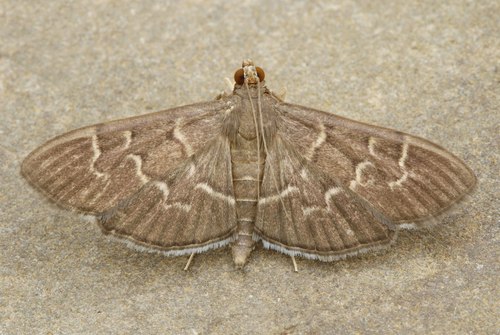
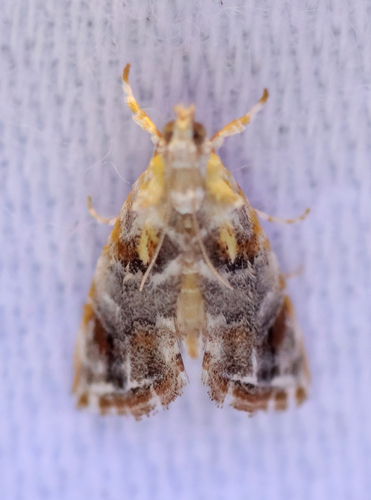
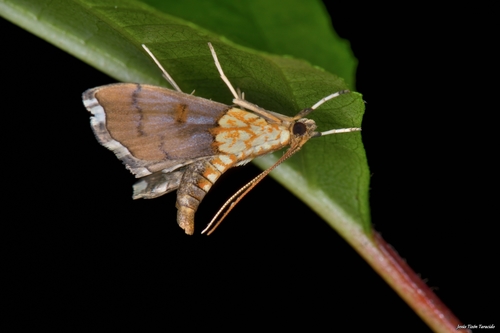
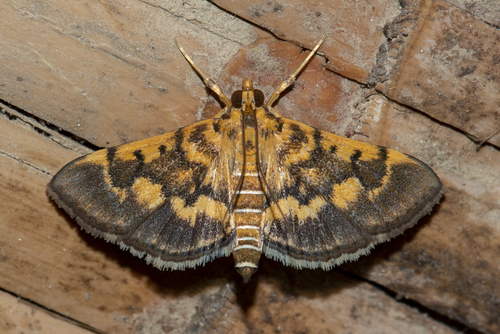
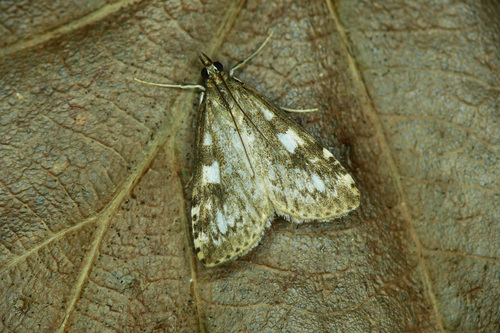
Udea olivalis is a moth species belonging to the Crambidae family. It was first described by Michael Denis and Ignaz Schiffermüller in 1775, and can be found in Europe. This moth has a wingspan of 24 to 28 mm. Its forewings are greyish ochreous or brownish, and are densely sprinkled with dark fuscous. The forewing lines are barely darker than the base color and indistinct; the second line is serrate, often edged with white on its posterior side, and preceded by a white spot in the middle. This line is curved, with an abrupt deep inward sinuation below the middle. The large orbicular and reniform discal spots on the forewings are darker, and are separated by a subquadrate white spot. The posterior half of the forewing costa is whitish, dotted with dark fuscous. The hindwings are white, with a light grey dorsal half; they have two dark grey discal dots and a fuscous terminal fascia. The larva is light green, with a dark green dorsal line and large black spots. The larva's head and the plate of its second segment are freckled with black. The adult moth flies from May to August, depending on location. The larvae feed on a range of herbaceous plants, including Hedera helix, Lychnis, Urtica, Symphytum officinale, and members of the Lamiaceae.