About Udaspes folus (Cramer, 1775)
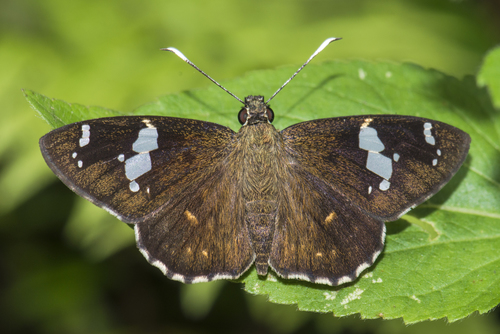
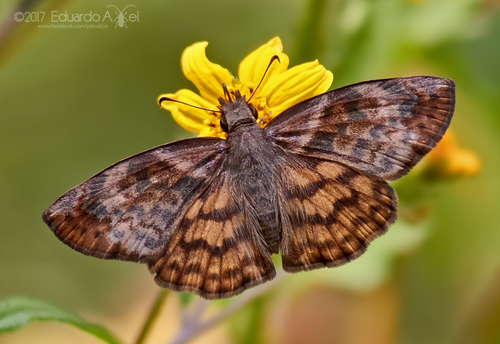
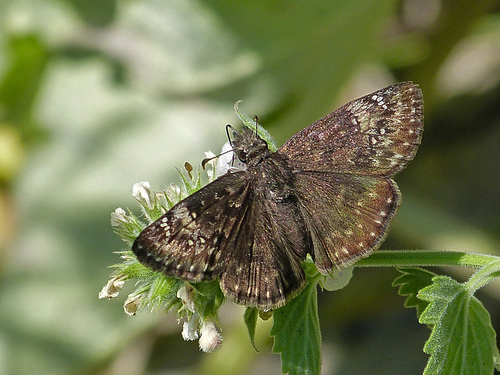
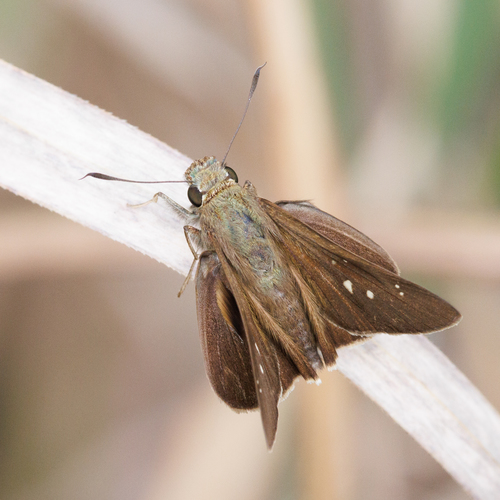
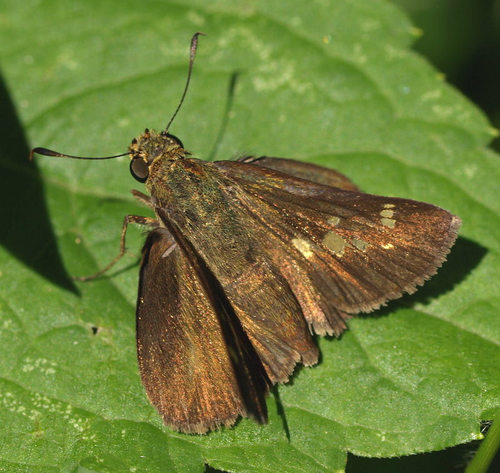
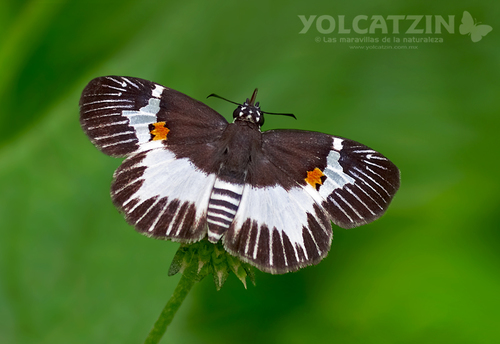
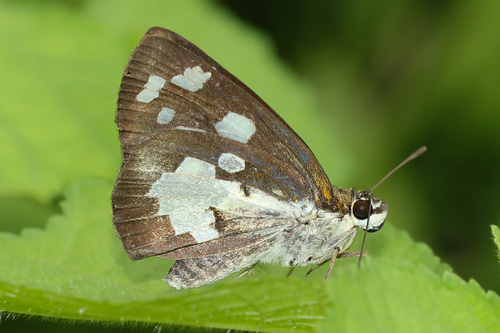
This insect is scientifically named Udaspes folus (Cramer, 1775), commonly called the grass demon. It is a small butterfly with a wingspan of about 4 to 4.8 cm. Males have a black upperside; the basal half of both wings is covered with minute yellowish scales, and all markings are pure white and semi-hyaline. On the male forewing, a large white spot fills the end of the cell. Two similar conjoined spots sit outwardly below this large spot, extending from beneath vein 4 to the sub-median vein, and are hardly separated from each other by vein 2. There are four connected sub-apical spots, with the uppermost being minute. Two similar spots sit below the sub-apical spots, closer to the outer margin, and a small spot sits between these lower spots and the two large conjoined spots. The male hindwing has a very large medial white patch with a sinuous margin all around; the abdominal area is covered with yellowish hairs. The underside of the wings is paler than the upperside. Forewing markings match those on the upperside. On the hindwing, the white medial patch extends to the abdominal margin from near the costa to one-third above the anal angle. The extension of this patch is suffused with grey, and also extends narrowly to the outer margin. Double blackish-brown lunular marks sit within the white space at the bases of the sub-median nervules. Cilia are blackish, alternating with white. Antennae are black; palpi, head and body match the wing color, are whitish on the underside; legs are brown above and whitish beneath. Females are identical to males in appearance, but their spots are larger. Overall, this butterfly is black with a large white spot on the upperside of the hindwing and several smaller white spots on the forewing, and its underside is mostly white with brown edges and spots. This species ranges across Sri Lanka, India, Nepal, Myanmar, China, Indochina, Taiwan, Japan, Thailand, the Malaysian Peninsula, Singapore, Borneo, and Indonesia. It inhabits deciduous and semi-evergreen forests. It prefers the edges of open spaces, rather than deep forest shade or open sunlight. It is most abundant in the more open regions of hilly jungle, and can also be encountered on plains some distance from this hilly terrain. It occurs up to 8,000 feet (2,400 m) in the hills of South India, and up to 5,000 feet (1,500 m) in the Himalayas. Adult butterflies emerge in February or March, and lay eggs before they die. Eggs remain dormant until the rains, which usually fall in May, when eggs hatch. Caterpillars pupate in September and October, and adults emerge four to six months later. In some cases caterpillars pupate later, and in these cases the pupa remains dormant throughout the dry season, until May when the rains begin. The grass demon uses ginger, turmeric, their relatives Curcuma aromatica, Curcuma decipiens, Hedychium sp., other plants of the family Scitaminae, Zingiber sp., and grasses as food plants.