About Udara akasa (Horsfield, 1828)
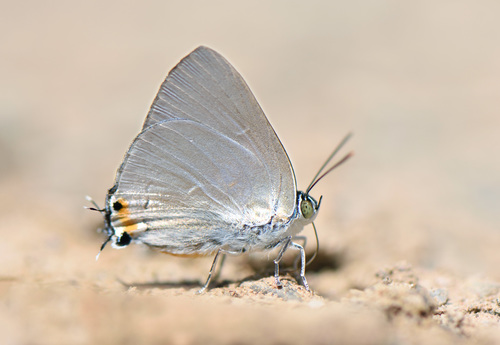
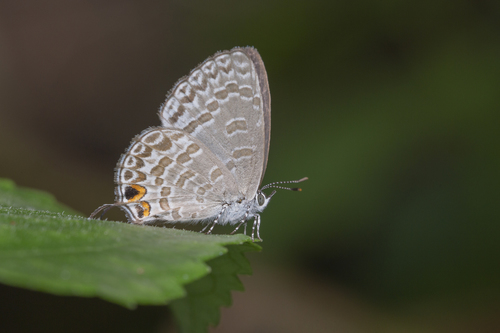
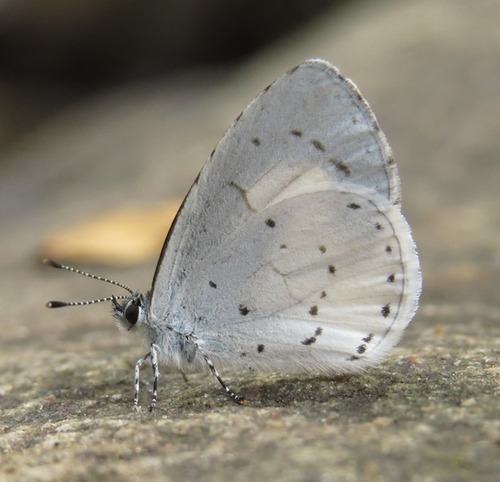
This species, scientifically named Udara akasa (Horsfield, 1828), exhibits distinct sexual dimorphism in its external markings. For males, the upperside of the forewing is black, with a medial triangular area extending outward from the base to the disc that is white. This white area is suffused with iridescent blue at its base and anterior portion, and the blue spreads upward onto the black costal margin. Along the dorsum, the black ground color is much paler, appearing as diffuse fuscous in most specimens. The upperside of the male hindwing is white, with the basal third and the entire costal margin broadly suffused with fuscous. The fuscous at the posterior portion of the base is overlaid with iridescent blue; there is also a subterminal series of fuscous-black dots and a distinct but very slender black anteciliary line. On the underside of both wings for males, the base color is white with a very slight bluish tinge, and all markings are fuscous black, minute, and very slender. The male forewing underside has a short discocellular line, followed anteriorly by a strongly curved, discal series of very short detached lines, and a more or less obsolescent transverse series of subterminal dots. The male hindwing underside has three subbasal dots arranged in a transverse line, a short line on the discocellulars, a spot below the middle of the costa with a smaller spot positioned below it, an irregular sinuous posterior discal series of five or six minute spots, and a perfectly regular subterminal series of similarly sized spots. The cilia of both the forewings and hindwings are white for both sexes. The antennae, head, thorax, and abdomen are blackish, with the antennae ringed with white; on the ventral side, the palpi, thorax, and abdomen are snow-white. Females are very similar to males overall. On the female upperside, the white area is much more extended on both forewings and hindwings. On the female forewing, the white area spreads well into the cell, and three-fourths of the female hindwing is white; the dusky basal and costal areas are much more restricted than in males. Iridescent blue suffusion is entirely absent in many female specimens, and only very faintly visible in a small number. The subterminal series of black dots that are distinct in males are generally faint and obsolescent in females. On the underside, female markings match those of males but are less distinct. The antennae, head, thorax, and abdomen of females are identical to those of males. This species is found in Sri Lanka, the Western Ghats, and Malaya.