About Uapaca bojeri Baill.
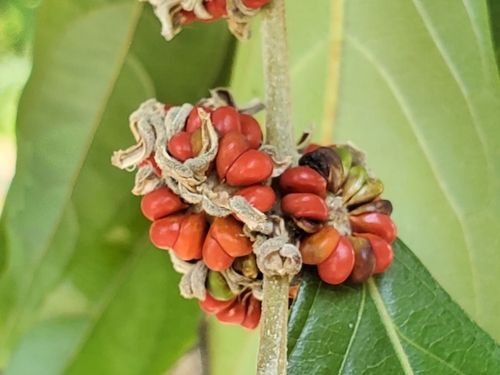
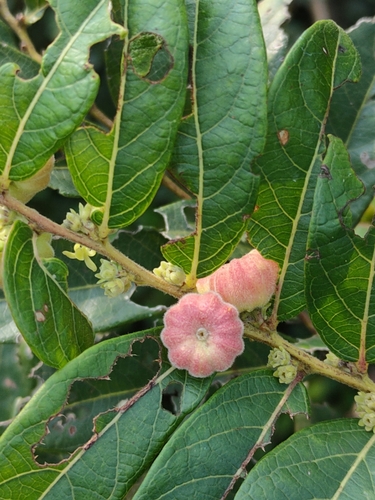
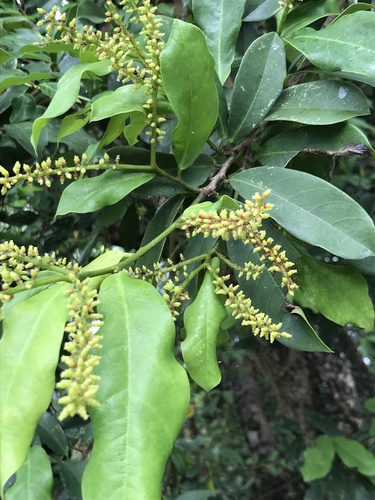
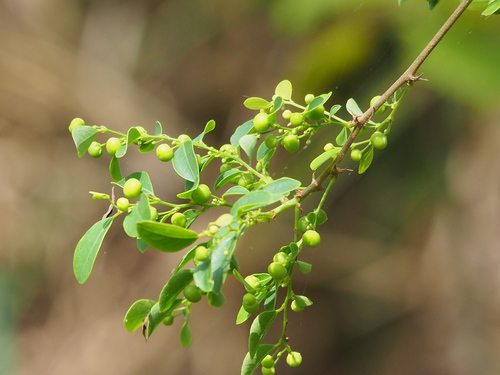
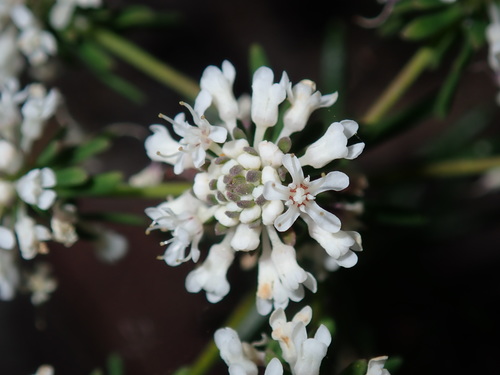
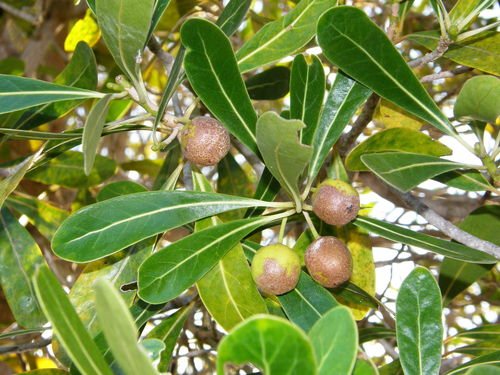
Uapaca bojeri Baill., commonly called tapia, is a tree that can reach heights of 10–12 meters (33–39 feet), though it most commonly grows between 3 and 5 meters (9.8–16.4 feet) tall. It has alternate, sclerophyllous leaves, thick furrowed bark, and is monoecious. Its flowers emerge from March to September. Male flowers have five stamens and five tepals, and grow in dense rounded clusters enclosed in an involucre of 7–8 bracts. Female inflorescences are reduced to a single flower with a trilocular ovary, and are also surrounded by bracts. Its fruits are drupes 2–3 centimeters (0.79–1.18 inches) in diameter. Unripe fruits are green to yellow, turning brown when mature. Ripe fruits hold a sweet, sticky mesocarp and three seeds.
Tapia is endemic to the central highlands of Madagascar, within the Madagascar subhumid forests ecoregion, growing at altitudes between 500 and 1,800 meters (1,600 to 5,900 feet). Its main known populations are located in the Imamo zone west of Antananarivo, Col des Tapia between Antsirabe and Ambositra, the Itremo massif, and Isalo National Park. Within a broader sub-arid to sub-humid climate zone, tapia woodlands grow in drier rain-shadow microclimates, primarily on acidic soils formed from sandstone, quartzite, and schist.
In the vegetation classification of the Atlas of the Vegetation of Madagascar, vegetation dominated by this species is called tapia forest, where tapia is the dominant and characteristic species. The canopy of intact tapia forest reaches 10–12 meters (33–39 feet) tall, and other tree species in this forest belong to the families Anacardiaceae, Asteraceae, Asteropeiaceae, Rubiaceae, and Sarcolaenaceae. All trees in this community are pyrophytes with thick, fire-resistant bark. The understory of tapia forest is made up of ericoid shrubs, grasses, and often lianas. Degraded tapia forest has a more open canopy, lower species diversity, and is co-dominated by Sarcolaena oblongifolia and Pentachlaena latifolia alongside tapia.
As a root-symbiotic tree, tapia forms both arbuscular mycorrhiza and ectomycorrhiza. Known ectomycorrhizal fungi associated with tapia belong to the genera Afroboletus, Amanita, Boletus, Cantharellus, Gyroporus, Lactarius, Leccinum, Rubinoboletus, Russula, Scleroderma, Suillus, Tricholoma, and Xerocomus. Among these associated fungi is the edible chanterelle Cantharellus platyphyllus ssp. bojeriensis, which is only found growing under tapia.
Tapia regeneration occurs mostly through resprouting after coppicing and via root sprouts, which matches the regeneration pattern of miombo woodlands in Eastern Africa. Tapia seeds have only limited capacity for dispersal and dormancy.
Local communities use tapia trees and the tapia forests they form for a wide range of purposes. The edible fruits are collected only after they have fallen to the ground, as a local taboo (fady) forbids picking fruits directly from the tree. Collected fruits are both consumed by local households and sold commercially. Cocoons from the tapia silkworm Borocera cajani, called landibe in Malagasy, are also harvested to produce wild silk, which is traditionally used for burial shrouds and holds local market value. Other common uses include harvesting fuelwood, collecting edible mushrooms, berries, and edible insects, harvesting herbal medicines, and hunting, including for two species of tenrec.