About Tyromyces pulcherrimus (Rodway) G.Cunn.
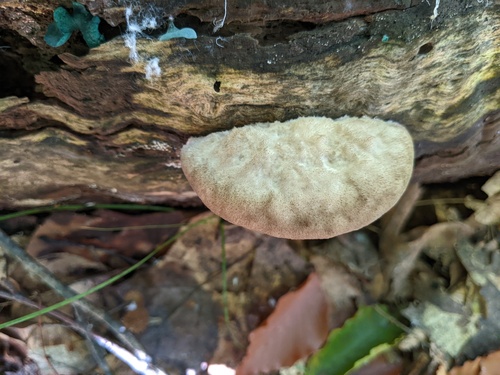
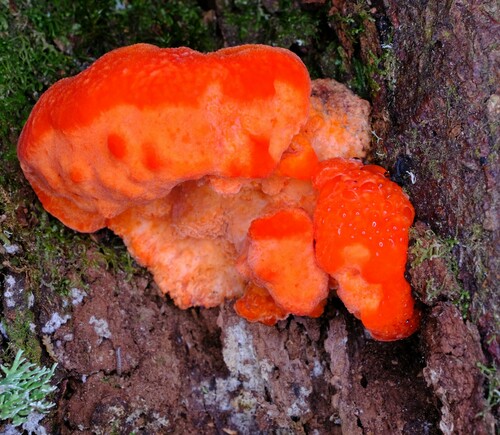
The scientific name of this species is Tyromyces pulcherrimus (Rodway) G.Cunn. Its fruit bodies are bracket-shaped caps 3–8 cm (1.2–3.1 in) across, and they are sessile, meaning they do not have a stipe and attach directly to their growing substrate. When fresh, the cap is cherry red or salmon in colour, and it fades to brownish as it dries. The cap surface can be hairy, especially close to the attachment point. The pores on the underside of the cap are red, with roughly 1 to 3 pores per millimetre. The flesh is soft, thick, red, and watery, with no distinct odour. Tyromyces pulcherrimus is inedible. This fungus has a monomitic hyphal system, meaning it only contains generative hyphae. These hyphae have clamps, and are sometimes covered with granules, or an oily-looking orange substance. The hyphae in the context (flesh) are arranged in parallel, and are strongly agglutinated to form dense, tightly packed tissue. Cystidia are absent from the hymenium. The basidia are club-shaped, typically have four sterigmata, and measure 15–23 by 6.5–7.5 micrometres. Its spores are ellipsoid to roughly spherical, hyaline (translucent), and measure 5–7 by 3.5–4.5 micrometres. Tyromyces pulcherrimus is a white rot fungus that grows on exposed heartwood of multiple tree species. It has been recorded growing on Nothofagus cunninghamii (southern beech) in Victoria and Tasmania, and on Nothofagus moorei (Antarctic beech) in Queensland and New South Wales. In Tasmania, available evidence indicates it prefers wet forest habitats, including rainforest and wet sclerophyll forest. In Brazil, it is an introduced species recorded on imported eucalyptus trees, where it has been found in Rio Grande do Sul State. In New Zealand, the fungus has been recorded on Fuscospora fusca (red beech) and Lophozonia menziesii (silver beech).