About Tyria jacobaeae Linnaeus, 1758
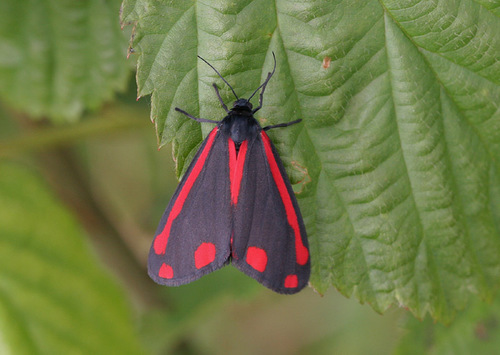
The cinnabar moth, with the scientific name Tyria jacobaeae Linnaeus, 1758, is a brightly colored moth of the Arctiinae subfamily. It is native to Europe, western and central Asia, and ranges east across the Palearctic through Siberia to China. It has been intentionally introduced to New Zealand, Australia, and North America to control ragwort, the primary food plant for its larvae. The moth gets its name from the red mineral cinnabar, which matches the red patches on its mostly black wings. This species was first formally described by Carl Linnaeus in the 10th edition of his 1758 work Systema Naturae. Adult cinnabar moths are about 20 mm (0.79 in) long with a total wingspan of 32–42 mm (1.3–1.7 in). They are day-flying insects with characteristic pinkish-red and black wing patterns. There is very little natural variation in this patterning, though rare variant forms include yellow markings replacing the red, all-red forewings with a black border, or entirely black wings. Like many other brightly colored moth species, cinnabar moths are unpalatable to predators. Their larvae use species in the genus Senecio as food plants, with many Senecio species recorded as larval food sources. For introduced populations using New World Senecio and Packera species, long-term successful population establishment has only been confirmed on the North American native plant Senecio triangularis. Other plant species, such as groundsel, are sometimes used by larvae, but this leads to reduced larval and overall population survival. Newly hatched larvae feed on the underside of ragwort leaves, in the same area where their egg masses were laid. Larvae absorb and assimilate toxic, bitter-tasting alkaloids from their food plants, which makes them unpalatable to predators as well. Both larvae and adult moths have bright warning coloration, so they are rarely eaten by most predators. The main exception is various cuckoo species, which regularly eat hairy and poisonous caterpillars including cinnabar moth larvae. Adult female cinnabar moths can lay up to 300 eggs total, most often in batches of 30 to 60 placed on the underside of ragwort leaves. When caterpillars hatch, they feed in the immediate area around their hatched eggs. As they grow larger and molt through successive instar stages, they shift to feeding mainly on the plant’s leaves and flowers, and can be found active out in the open during the day. Like the larvae of several other Arctiinae moth species, cinnabar caterpillars may become cannibalistic. This behavior most often occurs when food is scarce, and they will feed on other cinnabar moth larvae. Young newly hatched larvae are pale yellow, but later larval stages develop distinct jet-black and orange/yellow stripes. Fully grown larvae can reach up to 30 mm (1.2 in) in length, and are extremely voracious eaters. Because they experience very low predation, large cinnabar larval populations can completely strip all vegetation from entire patches of ragwort. Very few larvae typically survive to reach the pupal stage, mainly because they often consume all available food before reaching maturity. This lack of food may explain the species’ tendency for apparently random cannibalistic behavior, as many larvae would otherwise die from starvation. In addition to predation by cuckoos, cinnabar larvae are also preyed on by the ant species Formica polyctena. This species overwinters in the cocoon stage at ground level.