About Tyrannus niveigularis P.L.Sclater, 1860
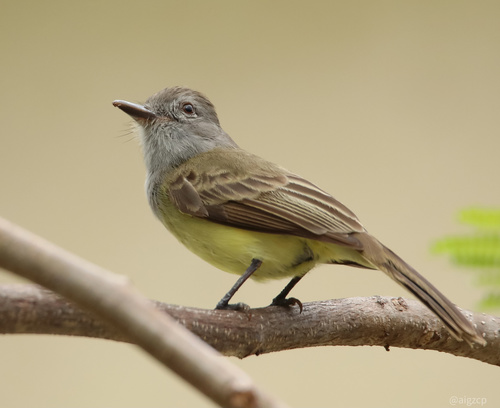
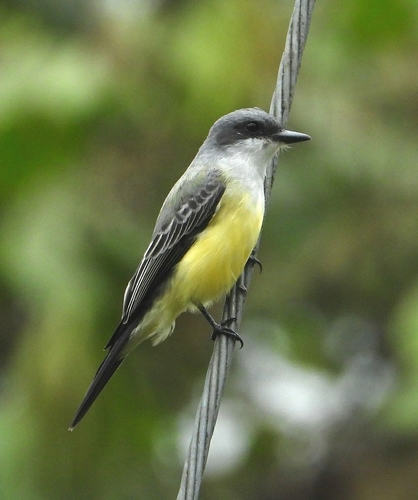
This species, the snowy-throated kingbird, has the scientific name Tyrannus niveigularis P.L.Sclater, 1860. Adults measure 18.5 to 19 cm (7.3 to 7.5 in) in length; one recorded male weighed 34.4 g (1.2 oz). Males and females have identical plumage. Adult snowy-throated kingbirds have gray crowns and napes, with a partially hidden yellow patch at the center of the crown. A thin black band runs across the forecrown and lores, which widens into a mask that extends to the ear coverts. Most of their upperparts are pale gray, with more olive coloring on the lower back and rump. Their wings are dusky, with whitish edges along the coverts and secondaries. Their tail is blackish and ends in a square tip. Their cheeks and throat are white, transitioning to pale gray on the breast. Their belly and undertail coverts are pale yellow. They have a dark iris, a black bill, and black legs and feet. The snowy-throated kingbird is distributed west of the Andes, starting from the Nariño Department in far southwestern Colombia, extending south through Ecuador into Peru, reaching as far as the northern La Libertad and southwestern San Martín departments of Peru. During the breeding season, it inhabits gallery forest, deciduous forest, arid scrublands, secondary forest, and agricultural areas that still retain some tree cover. In the non-breeding season, it occurs in more humid landscapes in northern Ecuador, and likely also in Colombia. In terms of elevation range, it is found below 1,500 m (4,900 ft) in Colombia, mostly below 500 m (1,600 ft) in Ecuador, and below 700 m (2,300 ft) in Peru.