About Tyrannus forficatus (Gmelin, 1789)
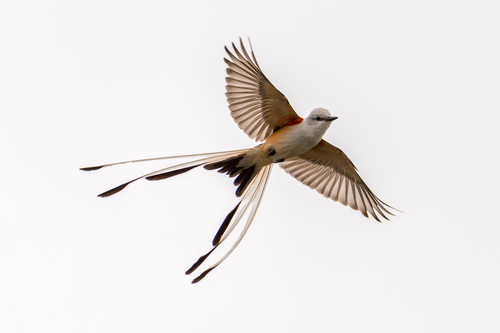
This species, known scientifically as Tyrannus forficatus (Gmelin, 1789), can be described by the following physical characteristics. Adult birds have pale gray heads and upper parts, light underparts, salmon-pink flanks and undertail coverts, and dark gray wings. The axillars and a patch on the underwing coverts are red. Their extremely long, forked tails, which are black on the upper surface and white on the underside, are characteristic and easily identifiable. When mature, males can reach up to 15 inches (38 cm) in total length, while females have tails up to 30% shorter than those of males. For mature individuals, the wingspan measures 38.1 cm (15.0 in), and body weight can reach up to 43 g (1.5 oz). Immature birds have duller plumage and shorter tails than adults. Many individuals of this species have been reported to reach more than 40 cm (16 in) in total length.
Regarding distribution and habitat, this species' breeding habitat is open shrubby country with scattered trees. This breeding range covers the south-central United States: Texas, Oklahoma, Kansas, western portions of Louisiana, Arkansas, and Missouri, stretching west to far eastern New Mexico, and extending into northeastern Mexico. Occasional stray individuals have been recorded as far north as southern Canada and Upstate New York, as far east as Florida and Georgia, and have also been reported in the West Indies. The species migrates through Texas and eastern Mexico to reach its non-breeding winter range, which extends from southern Mexico to Panama. Pre-migratory roosts and flocks migrating south can contain as many as 1000 individual birds.