About Tyrannus dominicensis (Gmelin, 1788)
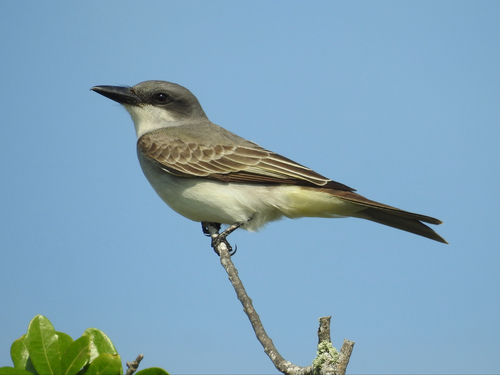
The adult gray kingbird (Tyrannus dominicensis) is an average-sized kingbird, measuring 23 cm (9.1 in) in length and weighing 37 to 52 g (1.3 to 1.8 oz). Its upperparts are gray, with brownish wings and tail, and its underparts are white with a gray tinge to the chest. The head has a concealed yellow crown stripe and a dusky mask through the eyes. Its dark bill is heavier than that of the related, slightly smaller tropical kingbird. The sexes are similar in appearance, but young birds have rufous edges on the wing coverts, rump and tail. The call is a loud rolling trill, pipiri, pipiri, which is the origin of many of its local onomatopoeiac names, like pestigre or pitirre in the Spanish-speaking Greater Antilles, or petchary in some English-speaking islands. Gray kingbirds are found in increasing numbers in Florida, U.S. It is more often found inland now, though it was previously restricted to the coast. It breeds from the extreme southeast of the United States, mainly Florida, as well as Central America, and through the West Indies south to Venezuela, Trinidad and Tobago, the Guianas, and Colombia. Northern populations are migratory, wintering on the Caribbean coast of Central America and northern South America. Several vagrant populations are known from the Northeastern United States. It favors tall trees and shrubs, including the edges of savanna and marshes. Gray kingbirds wait on an exposed perch high in a tree, occasionally sallying out to feed on insects, such as bees, dragonflies, wasps and beetles, which are their staple diet. They also eat small fruits and berries depending on availability; fruits and berries make up one fifth of their daily diet. Spiders and small lizards are occasionally eaten.