About Tyrannus crassirostris Swainson, 1826
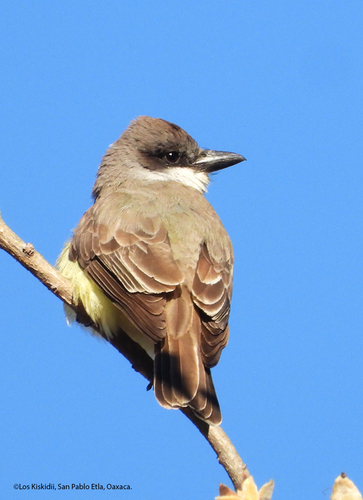
The thick-billed kingbird (Tyrannus crassirostris Swainson, 1826) measures approximately 25 cm (9.8 in) in length, and weighs between 52 and 59 g (1.8 to 2.1 oz). Females are slightly smaller than males, and the two sexes have nearly identical plumage. Adults of the nominate subspecies have dark grayish brown plumage on the forehead, crown, lores, and ear coverts, with white cheeks. Crown feathers form a small crest. Both sexes have a partially hidden lemon or canary yellow patch at the center of the crown, although this patch is narrower in females. Both sexes also have a grayish brown nape that is paler than the rest of the head. Most of their upperparts are grayish olive, with grayish brown uppertail coverts. Their wings are mostly deep grayish brown, with pale grayish olive lesser coverts. Remiges have thin pale buffy brown or cinnamon edges on their upper side, and thin yellowish white edges on the inner webs of their underside. Their tail is deep grayish brown, with pale buffy brown or cinnamon feather edges. Their chin and throat are white, their breast ranges from whitish to very pale gray, and their sides, flanks, and undertail coverts range from very pale canary to deep primrose yellow. Subspecies T. c. pompalis has less olive upperparts and paler yellow underparts than the nominate subspecies, though these differences have also been linked to feather wear. Both subspecies have a dark iris, a stout dark bill, and blackish legs and feet. There are two recognized subspecies of thick-billed kingbird. The more northerly subspecies is T. c. pompalis. In the United States, it occurs in extreme southeastern Arizona and extreme southwestern New Mexico, ranging south along the Pacific side of Mexico to Colima. A small number of nesting records exist from the Big Bend region of southern Texas. This subspecies has also strayed further north into Arizona, as well as to British Columbia, California, Colorado, and Baja California. The nominate subspecies is found on the western side of Mexico from Colima south to Chiapas, and occasionally occurs in western Guatemala. The thick-billed kingbird occupies different habitats across its range. In the United States, it breeds along streams and rivers with moderately open floodplains, rather than in narrow canyons. Further south, it occurs primarily in tropical deciduous forest, and less often in riparian zones; in the far southern part of its range, it is found in riparian zones within arid scrublands. It can be found at elevations up to 2,000 m (6,600 ft).