About Tyrannus couchii S.F.Baird, 1858
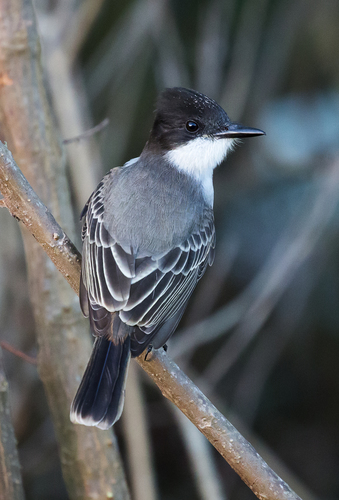
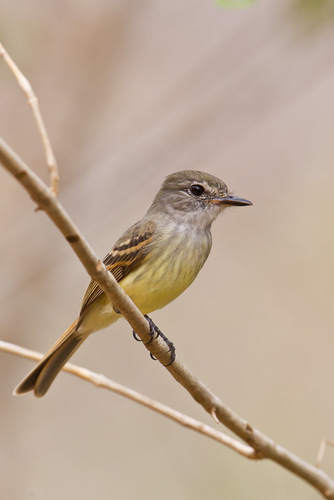
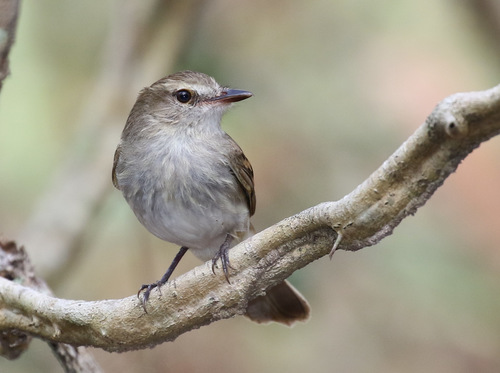
Couch's kingbird (Tyrannus couchii S.F.Baird, 1858) reaches about 7 inches in length, with a large head and bill, and a dark forked tail. Its head is pale gray with contrasting darker cheeks; upperparts are grayish-olive. It has a pale throat, a darker upper breast, and a bright yellow lower breast. Juveniles have browner underparts than adults, plus pale edges on their wings. This species is native to southern Texas, eastern Mexico, Belize, and northeastern Guatemala. It inhabits lightly wooded areas including sparse forests, suburban areas, thorn forests, and edges of wooded streams. It prefers living near water, especially rivers, and is often found near roadsides and forest edges. One vagrant individual was sighted in New York City in December 2014, attracting attention from many birdwatchers. The species' nesting behavior is not precisely documented, but it is thought to be similar to that of the tropical kingbird. Couch's kingbird nests in lightly wooded areas, frequently choosing sugar hackberry, cedar elm, Texas ebony, and Mexican ash trees as nest sites. The flat, cup-shaped nest is most likely built by the female. It is constructed from twigs, leaves, weeds, moss, and bark, then lined with softer fine materials such as rootlets, plant down, and Spanish moss. The nest sits horizontally on higher branches 8–25 feet above the ground, and adults aggressively guard the nest site by chasing away larger birds. The incubation period is unknown, but it is estimated to last a little over two weeks and be completed by the female. A female can lay up to five eggs, but most nests hold three to four eggs. The eggs are a warm pinkish-buff color, marked with splotches of darker brown and lavender. It is thought that both parents feed the nestlings, though little detailed information is available. Young Couch's kingbirds make their first flight around 2–3 weeks after hatching.