About Tyrannus albogularis Burmeister, 1856
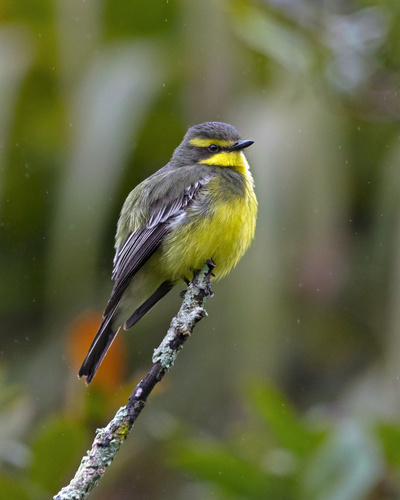
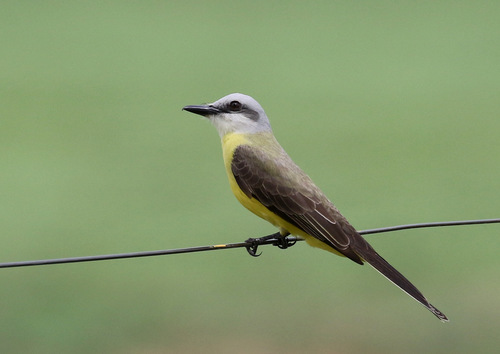
Tyrannus albogularis Burmeister, 1856, commonly called the white-throated kingbird, measures 20 to 21 cm (7.9 to 8.3 in) in length and weighs 35 to 38 g (1.2 to 1.3 oz). Males and females have identical plumage. Adult individuals have a mostly pale gray head, with a partially hidden pale orange or yellowish patch at the center of the crown. A dusky band runs from the lores to the ear coverts, forming a visible "mask". Their upperparts are mostly bright olive green. Their wings are dull blackish brown, with pale edges on the coverts and secondaries. Their tail is black and notched, their throat is white, and their underparts are bright yellow with a very faint olive tinge on the breast. They have a dark iris, a stout dark bill, and blackish legs and feet.
The full range of the white-throated kingbird has not been firmly established. It is confirmed to occur from eastern Ecuador and eastern Peru, eastward through northern Bolivia, southern Venezuela, Guyana, and Suriname, into most of Brazil. In Brazil, the eastern edge of its range roughly extends from Amapá south through Pará, Tocantins, and western Bahia and Minas Gerais, into Mato Grosso do Sul and São Paulo. McMullan's field guide to Colombia lists this species, but the South American Classification Committee of the American Ornithological Society (SACC) has no confirmed records from Colombia, so it classes the species as hypothetical there. The SACC also classes it as hypothetical in Argentina, and as a vagrant in French Guiana.
The white-throated kingbird lives in a variety of lowland tropical landscapes, most of which are fairly open and shrubby. These landscapes include cerrado, savannah, the edges of gallery forest, and stands of moriche palm, and sometimes other palm species. Across all its habitats, it is usually found near water. During the non-breeding season, it appears to also use other habitats including suburban and urban areas, but still tends to stay near water. In terms of elevation, it ranges from sea level to 1,000 m (3,300 ft) in Brazil. The few records of the species from Ecuador are all below 300 m (1,000 ft), and sight records from Venezuela exist as high as 900 m (3,000 ft).