About Tyrannulus elatus (Latham, 1790)
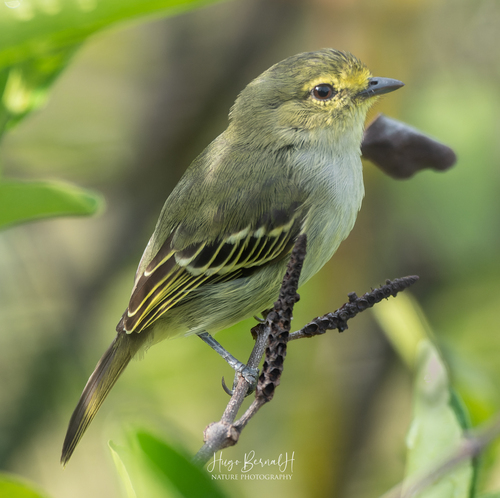
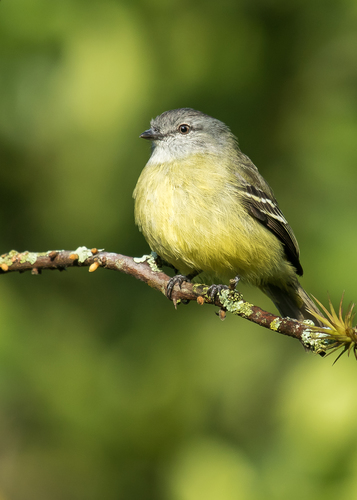
The yellow-crowned tyrannulet (Tyrannulus elatus (Latham, 1790)) is 10 to 11 cm (3.9 to 4.3 in) long and weighs 6.5 to 8 g (0.23 to 0.28 oz). Adult males have a slate-gray to dark brown or blackish crown, with a bright yellow to orange-yellow stripe running down the middle of the crown. Their nape and back are bright olive-green. They have a grayish supercilium, a thin dark line through the eye, and a pale gray lower face. Their wings are dusky with two white to yellowish white bars, and their tail is dusky olive. Their throat is pale gray, and their underparts are pale to medium yellow with an olive wash on the breast. Females are smaller than males, with a paler gray crown, paler mid-crown stripe, and slightly paler upperparts. Both sexes have a brown iris, a short rounded black bill, and gray legs and feet.
The yellow-crowned tyrannulet has a disjunct distribution, with two main populations. The first population ranges from north-central Puntarenas Province and northern San José Province on the Pacific slope of Costa Rica, through Panama, south through western Colombia into western Ecuador as far as central Guayas Province, and east through northern Colombia into northwestern Venezuela. The second population occurs east of the Andes, from eastern Colombia south through Ecuador and Peru into northern Bolivia, and east through eastern Venezuela, the Guianas, and most of Amazonian Brazil.
This species lives in lowlands and foothills. It primarily inhabits humid evergreen forest, especially at forest edges and shrubby openings within the forest interior, though it can also be found in the interior canopy. It also lives in secondary forest, light woodland, coffee and citrus plantations, gardens, and suburban parks. The elevation range it occupies varies by location: it occurs up to 1,200 m (3,900 ft) in Costa Rica, 1,000 m (3,300 ft) in Colombia, 600 m (2,000 ft) in Ecuador, 1,050 m (3,400 ft) in Peru, and 1,200 m (3,900 ft) in Venezuela and Brazil.