About Typha minima Funck
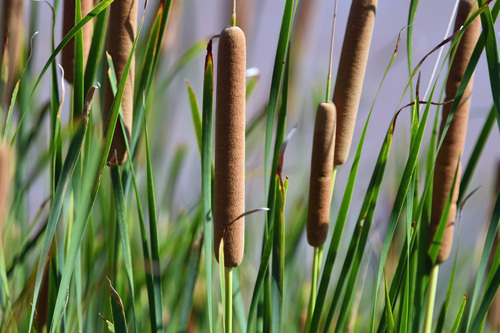
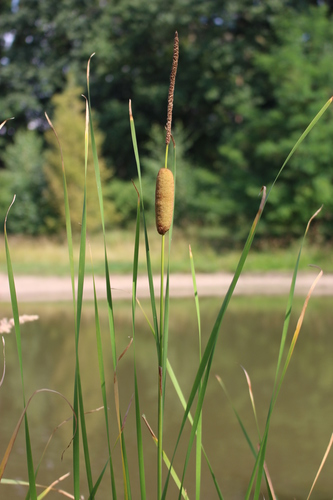
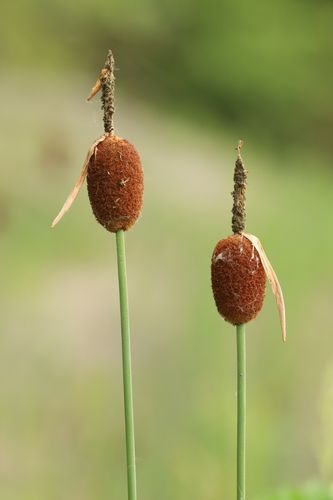
Typha minima Funck, the smallest species of cattail, is classified as a hemicryptophyte hydrophyte. This means it overwinters using submerged buds and is adapted to live in aquatic environments. It reproduces vegetatively through a short rhizome that is 5 to 8 millimeters thick, and grows up to 20 centimeters deep into the substrate. Plants reach an average height of 30 to 80 centimeters (12 to 31 inches), with a maximum recorded height of 140 centimeters (55 inches). Its stem is erect and unbranched. The leaves are blue-green, linear, very narrow, and non-shiny; they grow up to 30 centimeters (12 inches) long and 1 to 3 millimeters (0.039 to 0.118 inches) wide. This species is monoecious, meaning male and female reproductive structures grow on the same individual, but are held in two separate inflorescences. Its tiny flowers are unisexual and pollinated by wind. Staminate (male) flowers are yellowish, while pistillate (female) flowers are greenish. The female inflorescence is brownish and ellipsoid, and measures 2 to 5 centimeters (0.79 to 1.97 inches) long. After flowers fall off, its rachis remains hairy. A 1-centimeter (0.39-inch) long naked section of stem separates the female inflorescence from the male inflorescence, which is thinner and longer, and sits at the top of the vertical stem. Female flowers have a single stalked ovary surrounded by a thick fringe of hair. Male flowers have three individual stamens surrounded by only a few hairs. After blooming ends, male flowers disperse and leave the top of the stem bare, while the female inflorescence develops into a round brown seed spike. The main flowering season runs from May through June, and a second flowering period can occur in August. This is a rare plant that is widespread across temperate Europe and Asia. Its distribution is restricted to rivers of the Alps and Apennines, the Balkans, the Danube region, and the mountains of central Asia. Typha minima is a light-loving species that cannot tolerate shade. It grows on periodically flooded banks of slow-flowing, cool, pure water, as well as along lake margins, in marshes, ponds, and swamps, at altitudes between 0 and 1,000 meters (0 and 3,281 feet) above sea level.