About Typha angustifolia L.
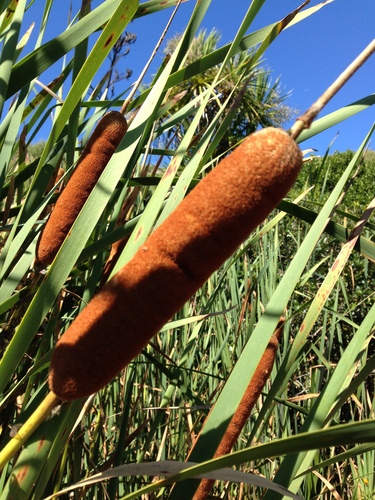
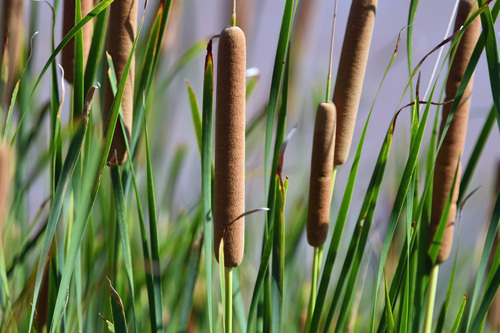
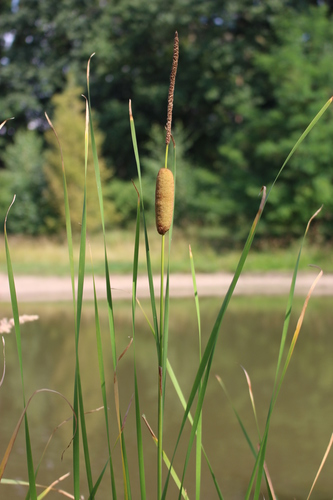
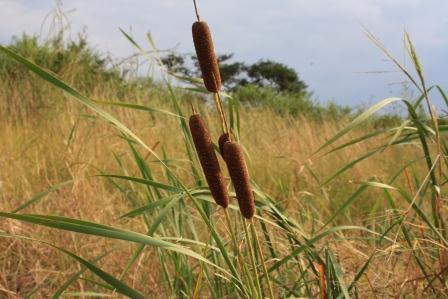
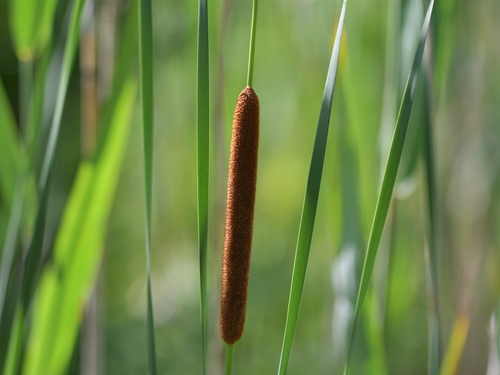
Typha angustifolia L. grows 1.5–2 metres (4 ft 11 in – 6 ft 7 in) tall, rarely reaching up to 3 m. It has slender leaves 3–12 mm (0.12–0.47 in) broad, which are noticeably more slender than the leaves of the related species Typha latifolia. Ten or fewer leaves grow from each vegetative shoot. The leaves are deciduous: they emerge in spring and die back in autumn. The flowering stem grows to 1–1.5 metres (3 ft 3 in – 4 ft 11 in) tall, and is distinctly shorter than the leaves, remaining hidden among them. This differs from T. latifolia, where the flowering stem is as tall as or taller than the leaves. Flowers grow in a dense cluster at the top of the main stem, split into a female section below, and a tassel of male flowers above. A 3–8 centimetres (1.2–3.1 in) gap of bare stem, rarely up to 12 cm, separates the female and male parts; this gap easily distinguishes the species from T. latifolia, which has no gap between its female and male flowers. Flowering occurs from June to July. After flowering, the male portion of the cluster falls off, leaving the female portion to develop a rusty-brown fruit head 13–25 mm in diameter, which matures into the characteristic sausage-shaped spike. The gap that previously separated female and male flowers remains visible as a smooth section at the base of the spike that once held the male flowers. Seed heads persist through the winter, then gradually break apart in spring to release tiny seeds embedded in hairs that help wind dispersal. This species has sturdy, rhizomatous roots that can extend 70 centimetres (28 in), and are typically 2–4 centimetres (0.79–1.57 in) in diameter. This species is universally accepted as native across most of Eurasia, and in far northwestern Africa. It is widely distributed across temperate and subtropical regions in these areas, growing in marshes, wetlands, and along the edges of ponds and lakes. Its native status in North America remains unclear, even though some sources accept it as native there. In 1987, researchers argued the species was introduced from Europe to North America, arriving via human activity on the east coast between 1800 and 1820. Later pollen evidence supported the idea that the species was present in North America before European contact, but further investigation has left the question unresolved: current consensus holds T. angustifolia is likely not native and has European origins, and it is only possibly native to the tidal wetlands of the eastern North American seaboard. Within North America, the species is thought to have recently spread from coastal areas to inland locations. The geographic range of Typha angustifolia overlaps with that of the very similar T. latifolia. T. angustifolia can be told apart from T. latifolia by its narrower leaves and the clear gap between the two floral regions, with staminate male flowers above and pistillate female flowers below on the flowering head. T. angustifolia often grows in deeper water than T. latifolia, and is more tolerant of wetlands with low eutrophication conditions. The two species can hybridize to produce Typha × glauca, a cross between T. angustifolia and T. latifolia. This is a sterile F1 hybrid that only reproduces vegetatively, forming extensive clonal colonies. Several parts of the plant are edible. In different seasons, edible parts include dormant sprouts on the roots and leaf bases, the inner core of the stalk, green bloom spikes, ripe pollen, and starchy roots. It can be prepared the same way as Typha latifolia. In Vietnam, the edible stem of this plant is called bồn bồn.