About Tylosema esculentum (Burch.) A.Schreib.
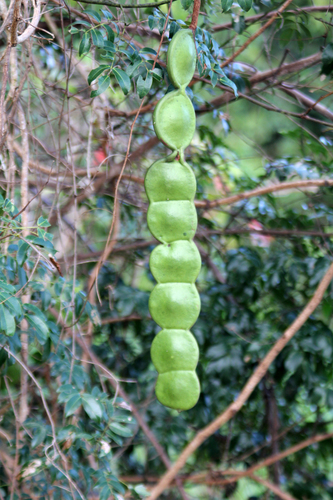
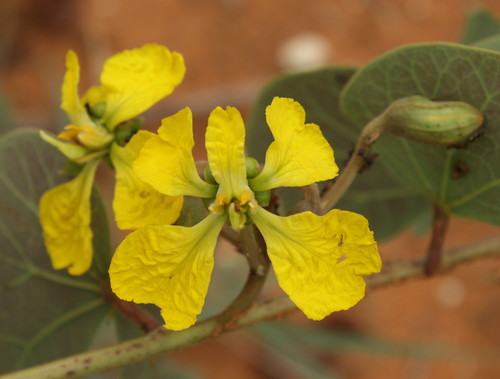
Tylosema esculentum (Burch.) A.Schreib., commonly called gemsbok bean, marama bean, or morama bean, is a long-lived perennial legume native to arid regions of southern Africa. Its stems grow at least 3 metres (9.8 ft) long in a prostrate or trailing growth form, and bear forked tendrils that help the plant climb. It produces racemes up to 25 millimetres (1 in) long that hold many yellow-orange flowers; after flowering, these develop into ovate to circular pods containing large brownish-black seeds, with each individual seed weighing 20–30 g (0.71–1.06 oz). This plant is an important food source for people living in the Kalahari, because its large seeds have high protein and oil content. Seeds are most often roasted, which creates a palatable flavor similar to cashew or chestnut. They can also be ground or boiled. A hard outer shell allows the beans to be stored for long periods without spoiling. The plant's tuber is also edible, but it must be harvested from plants that are only one or two years old; older tubers become astringent and overly fibrous. Flour made from Tylosema esculentum, produced from either heated or unheated marama beans, is protein-rich and has potential as a functional food ingredient. While studies on its nutritional and physicochemical properties are still limited, the protein-based ingredients derived from marama bean are similar to commercially available protein ingredients from soybean. This means the flour could potentially be used as a protein supplement when blended with cereal composite flours to improve overall protein quality. As a drought-tolerant perennial legume adapted to arid Southern African environments, this species is an important indigenous natural food source that supports rural livelihoods, especially for communities living in harsh, low-rainfall conditions. Its large tuber stores large amounts of water and soil nutrients, which lets it survive and grow in these harsh arid environments. Many families across Southern Africa grow marama bean locally, but most are not aware of its high nutritional value. Chemical analysis of 16 Tylosema esculentum samples collected from Botswana, Namibia, and South Africa confirmed that marama bean seeds have very high lipid and protein content: protein content ranges from 29-38%, lipid content from 32-42%, and dietary fiber content from 19-27%. These levels are higher than the nutrient content found in most other common legumes. In addition to being eaten whole, Tylosema esculentum can be processed to make other nutritional products including oil, milk, and flour. After learning about the high nutritional benefits of this legume, many Southern African families hope to see marama bean enter commercial markets, to help stabilize local food security and expand available food diversity.