About Tylopilus felleus (Bull.) P.Karst.
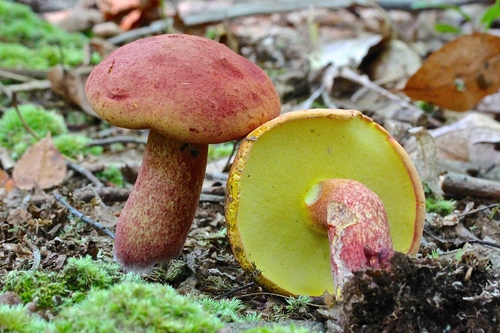
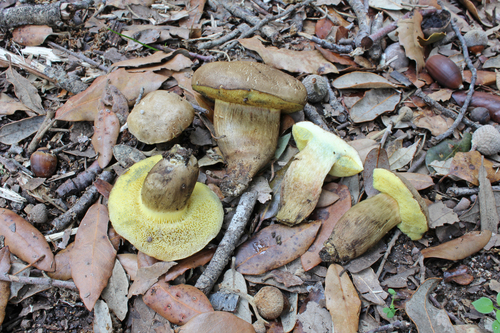
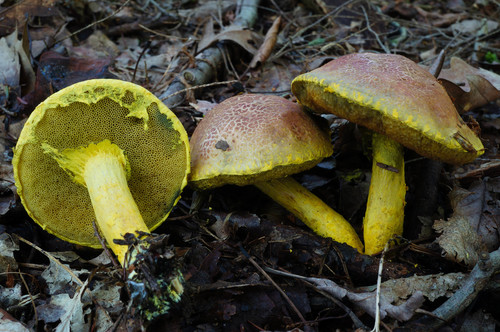
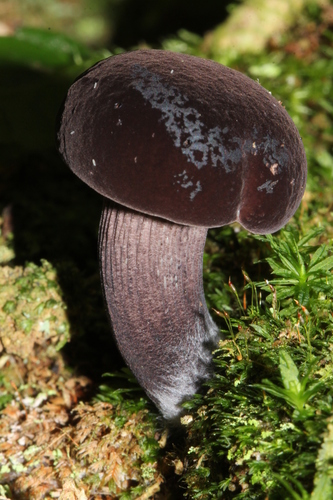
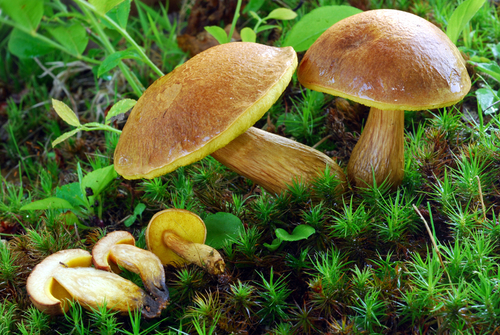
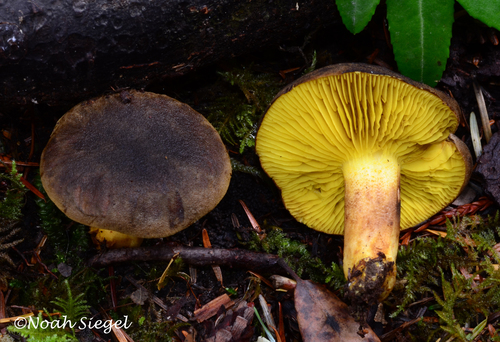
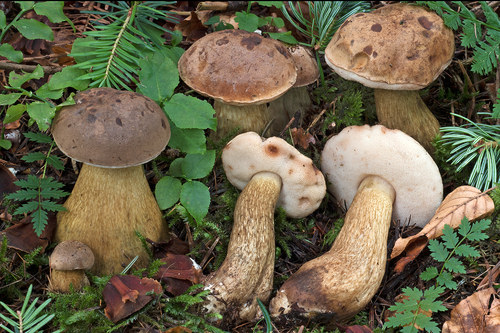
The cap of Tylopilus felleus grows up to 15 cm (6 in) in diameter, though some North American specimens reach 30 cm (12 in) across. Its colour ranges from grey-yellow to pale brown or walnut brown. The cap surface is slightly downy when young, and later becomes smooth with a matte finish. It starts out convex and flattens as it matures, and the cap skin cannot be peeled away from the underlying flesh. The pores on the underside of the cap are white when young and turn pinkish as the mushroom matures. They attach adnately to the stalk, and bulge downward as the mushroom ages. Bruising the pores turns them carmine or brownish; they often develop rusty-brown spots with age, and there are roughly 1 to 2 pores per millimetre. The pore tubes are long relative to the cap size, measuring 2–3 cm (0.8–1.2 in) deep in the central section of the cap. The stalk starts bulbous, then stretches and thins in its upper portion as it develops; the lower section of the stalk remains swollen, and sometimes shrinks at the base where it connects to its growing substrate. The stalk measures 7–10 cm (2.8–3.9 in) tall, rarely reaching 20 cm (7.9 in), and is 2–3 cm (0.8–1.2 in) wide; it can bulge to 6 cm (2.4 in) across at the base. It is lighter in colour than the cap, and covered in a coarse brown network of markings that have been compared to fishnet stockings in appearance. The flesh, which is described as "very appetising" in appearance, is white or creamy, and pink beneath the cap cuticle; it can also develop pinkish tones where it has been cut. It has a faint odour, which has been described both as pleasant and faintly unpleasant. The flesh is softer than that of other boletes, and becomes more spongy as the mushroom matures. It is intensely bitter, and is rarely infested by insects. The spore print is brownish with a reddish or pink tint. Spores are somewhat fusiform (spindle-shaped), smooth, and measure 11–17 by 3–5 μm. The four-spored, club-shaped spore-bearing cells (basidia) measure 18–25.6 by 7.0–10.2 μm. Pleurocystidia (cystidia located on the tube walls) are fusiform with a central swelling, thin-walled, and contain granular contents. They have sharp to tapered tips, with overall dimensions of 36–44 by 8.0–11.0 μm. Cheilocystidia located on the pore edges are similar in shape to pleurocystidia, and measure 24.8–44.0 by 7.3–11.0 μm. For Smith and Thiers's variety uliginosus, when the hymenium is mounted in Melzer's reagent, reddish pigment globules measuring 2–8 μm appear in the hyphae and throughout the hymenium, and a large 8–12 μm globule is present in the pleurocystidia. Several chemical tests can help confirm identification of this species. Applied to the cap flesh, formaldehyde turns the tissue pinkish; iron salts cause a colour change to greyish-green; aniline produces a lavender to reddish-brown colour; and phenol produces a purplish pink to reddish brown colour. Applied to the cap cuticle, nitric acid produces an orange-salmon colour; sulphuric acid creates an orange-red colour; ammonia usually produces a brown colour; and a potassium hydroxide solution usually produces an orange colour. Like all Tylopilus species, T. felleus is mycorrhizal. It grows in deciduous and coniferous woodland, often under beech and oak in well-drained acid soils that can be sandy, gravelly, or peaty. When found on calcareous (chalky) soil, it grows in moist, waterlogged areas with ample leaf litter. Fruit bodies grow singly, in small groups, or occasionally in small clusters with two or three joined at the base of the stem. Fruit bodies have also been found growing in cavities of old trees, on old conifer stumps, and on buried rotten wood. The fungus gets most of its required nitrogen from amino acids produced by breaking down proteins, with a smaller amount coming from the amino sugar glucosamine, a breakdown product of chitin, a major component of fungal cell walls. The mycorrhizal plant partner benefits from the fungus's ability to use these forms of nitrogen, which are often abundant in forest floors. Fruit bodies appear over summer and autumn, from June to October or even November, across many northern temperate zones. Large numbers may appear some years and none in others, generally in proportion to the amount of rainfall. Variety uliginosus, known from Michigan, grows among lichens and mosses under pines. In North America, T. felleus is found in eastern Canada, ranging south to Florida, west to Minnesota in the United States, and extending into Mexico and Central America. It is widespread across Europe, relatively common in many regions but rare or nearly absent in others. In Asia, it has been recorded near Dashkin in the Astore District of northern Pakistan, and as far east as China (where it has been found in Hebei, Jiangsu, Fujian, Guangdong and Sichuan provinces) and Korea. The intense bitter taste of the fruit body may contribute to insects avoiding it. The small fly species Megaselia pygmaeoides feeds on and infests T. felleus fruit bodies in North America, though it prefers other boletes in Europe. Fruit bodies can be parasitized by the mould Sepedonium ampullosporum. Infection causes necrosis of the mushroom tissue and turns it yellow, from the production of large amounts of pigmented aleurioconidia, which are single-celled conidia produced by extrusion from conidiophores. The bacterium Paenibacillus tylopili has been isolated from the mycorrhizosphere of T. felleus, the region around the fungus's subterranean hyphae where nutrients released by the fungus affect the activity of the soil microbial population. This bacterium excretes enzymes that let it break down the biomolecule chitin. T. felleus fruit bodies have a high capacity to accumulate radioactive caesium (137Cs) from contaminated soil, a trait linked to the deep soil penetration of the species' mycelium. In contrast, the species has a limited capacity to accumulate the radioactive isotope 210Po.