About Tylopilus alboater (Schwein.) Murrill
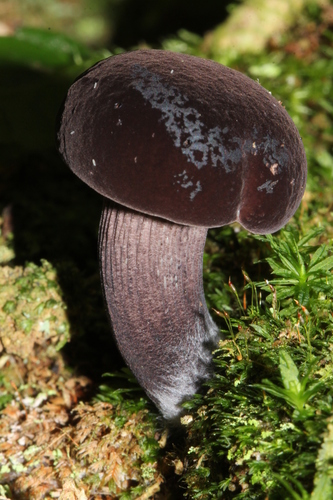
The cap of Tylopilus alboater starts convex, becoming broadly convex and eventually flattening as it matures, with a typical diameter between 3 and 15 cm (1 1/4 to 6 inches). The cap surface is dry and velvet-like, and may become rimose, meaning it develops a network of small cracks and crevices, with age. Initially, the cap is black to dark grayish brown, and young specimens have a whitish, fine powder-like bloom on the surface. Fruit bodies, especially young ones, are usually not infested by maggots or other insect larvae. As the mushroom matures, the bloom disappears and the cap color fades to grayish to grayish brown. The cap flesh is whitish, but turns pink to reddish gray and eventually black after being cut or injured. Spores are produced in basidia arranged in a vertical layer of tiny tubes on the underside of the cap, which forms a pore surface. This pore surface is whitish when young, turning dull pink or flesh-colored at maturity. When bruised, the pore surface first stains reddish and slowly turns black. The small pores are angular to irregular in shape, with roughly two pores per millimeter. The tubes are 5–10 mm (1/4–3/8 inch) deep, and are usually sunken around the point where they attach to the stem. The stem measures 4–10 cm (1 1/2–4 inches) long by 2–4 cm (3/4–1 1/2 inches) thick; it may be equal in width along its length, slightly thicker toward the base, or somewhat thicker in the middle. It matches the cap's color or is paler. The stem surface is usually smooth, though some specimens may be slightly reticulated near the top. The spore print ranges from pinkish to deep flesh color. Spores are oval to ellipsoid, smooth, and hyaline (translucent), measuring 7–11 by 3.5–5 μm. Basidia are club-shaped, four-spored, and measure 15–24 by 6–7.5 μm. Pleurocystidia, cystidia on the tube faces, are irregularly club-shaped, with dimensions of 20–36 by 7–10 μm. Cheilocystidia, found on tube edges, are club-shaped, rare, occur singly, and measure 18–32 by 7–9 μm. Rare caulocystidia on the stem grow in groups, with individual measurements of 24–30 by 6–9 μm. Clamp connections are absent from the hyphae of T. alboater. Tylopilus alboater is an edible mushroom with a pleasant odor and mild taste. It is considered one of the best edible species in the genus Tylopilus, a group most often known for bitter, unpalatable mushrooms. Frying slices of this mushroom develops a delicate, earthy, nutty flavor, and longer frying makes the cap pleasantly crisp. The mushroom can also be used for mushroom dyeing. Tylopilus alboater is a mycorrhizal species. Its fruit bodies grow on the ground, solitary, scattered, or in groups under deciduous trees, especially oak. Fruiting occurs in deciduous, coniferous, and mixed forests. Its dark color makes it hard to spot in the field. It fruits from June to September in North America, where it is widely distributed east of the Rocky Mountains. Its range extends from Quebec, Canada, south through New England to Florida, and west to Missouri, Michigan, and Texas; it is also found in Mexico. In Asia, it has been recorded from China (Anhui, Fujian, Guangdong, Guangxi, and Sichuan), Japan, Taiwan, and Thailand.