About Tylecodon paniculatus (L.fil.) Toelken
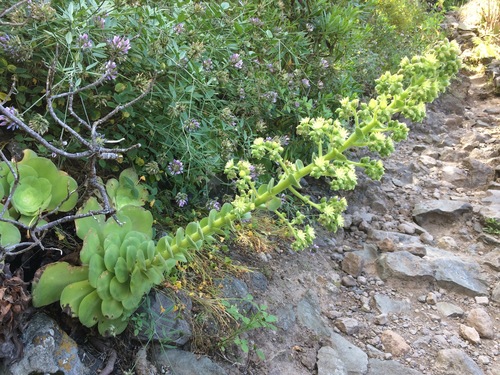
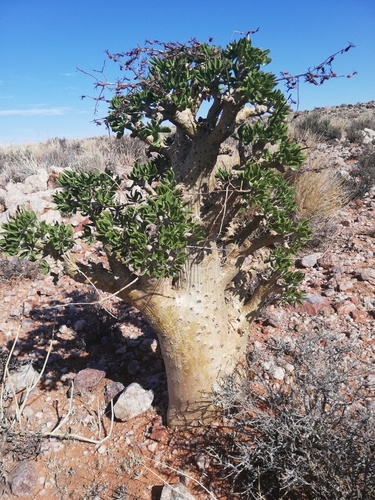
Tylecodon paniculatus (L.fil.) Toelken is a thickset, robust succulent dwarf tree that reaches 2.5–3 m in height. It has very thick stems, and usually forms a well-branched rounded crown. Its single main trunk and branches are covered in mustard-yellow to olive-green bark that peels in papery, semi-translucent sheets. Branches are short, with noticeable, prominent leaf scars. Its leaves are clustered and spirally arranged around the tips of growing stems, and are simple, produced during winter. The leaves are paddle-shaped, 5–12 cm long and 2–10 cm wide, thickly succulent, and bright yellowish-green. The leaf apex is broadly tapering to rounded, the leaf base tapers, and leaves have no petiole. This species is deciduous. Its inflorescences are striking, slender, ascending thyrses that grow up to 40 cm long, with bright crimson-red stalks. Flowers have five fused sepals and five fused petals, which form an orange-yellow to red urn-shaped tube 1.5–2.5 cm long, with spreading lobes. The ten stamens are pendulous when the flower is fresh, and become upright as the petal tube dries. Tylecodon paniculatus hybridizes with Tylecodon wallichii. It grows on rocky slopes in the Succulent Karoo habitat. This species occurs in arid, winter rainfall regions from Namibia to southwestern South Africa. Tylecodon paniculatus contains bufadienolide-type cardiac glycoside cotyledoside, which causes cotyledonosis, also called nenta poisoning (or "krimpsiekte"), in sheep and goats.