About Turritis glabra L.
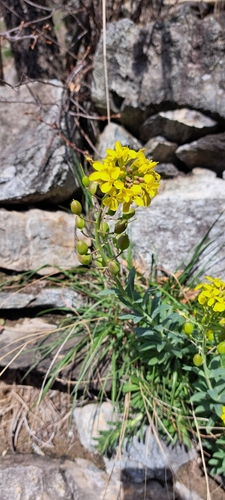
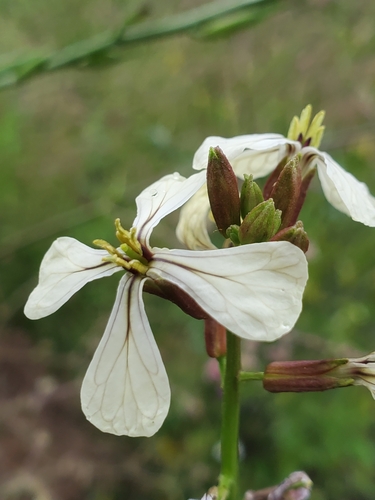
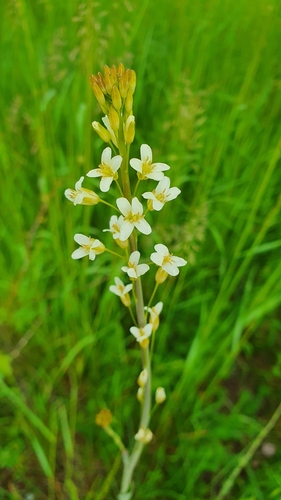
Turritis glabra, commonly called tower mustard, typically reaches 40 to 120 centimeters in height when fully grown. It may be stunted to as short as 30 centimeters, or reach 1.5 meters in height in exceptional cases. It is most often a biennial herb, but can occasionally grow as a short-lived perennial. It has a taproot with fibrous lateral roots. Plants usually produce several erect, mostly unbranched stems; the lower portions of these stems are grey and covered in simple hairs, while the upper portions are green and hairless (glabrous). Leaves first grow in a basal rosette, and later develop alternately along the main stem and branches. Basal leaves are blunt, with toothed or pinnatifid edges, and can grow up to 15 centimeters long. These leaves are typically pubescent (covered in hairs) on their upper surface, though they may be hairless in rare cases. Their shapes range from spatulate (spoon-shaped, narrow at the base and wider at the tip), to oblanceolate (narrow spear-shaped, widest near the middle), to oblong (a rounded rectangle longer than it is wide) with a broad tip. Basal leaves are most often 5 to 12 centimeters long and 1 to 3 centimeters wide, though they can be as short as 4 cm or as long as 15 cm. Leaves growing on stems (cauline leaves) are progressively smaller, less divided, and more pointed than basal leaves, and clasp the stem. Their shapes can be lanceolate (narrow spear-shaped blade), oblong-elliptic (a somewhat more rounded rectangle), or ovate (fully egg-shaped, wider at the base than the tip). The inflorescence is a terminal raceme holding numerous small white flowers on small pedicels (flower stems) up to 2 centimeters long. Each flower has four greenish sepals around 5 millimeters long, four pale yellow petals up to 1.7 centimeters long, six stamens, and one style. The fruit is a greenish silique up to 8 cm long by 1.7 cm wide, flattened, and held vertically parallel to the stem. The native distribution of tower mustard is moderately uncertain, as different botanical sources report different details for its range, based on records from Plants of the World Online (POWO) and NatureServe. POWO lists T. glabra as native to almost all of Europe, excluding only Ireland, Sardinia, and Corsica. In temperate Asia, POWO records it as native across most of the northwest, from Turkey and Iran north into central Asia, and west across Siberia from Chita Oblast, Irkutsk Oblast, and Krasnoyarsk Krai. In more southern parts of Asia, POWO lists it as native to Korea, Japan, Mongolia, Manchuria, north-central China, southeast China, Xinjiang, Nepal, and the western Himalayas; it is listed as introduced to Primorsky Krai, Sakhalin Island, and the Kuril Islands. In Africa, POWO records it as native to Algeria, Kenya, Morocco, Rwanda, Tanzania, Uganda, and the Democratic Republic of the Congo, and introduced to Lesotho, KwaZulu-Natal, the Cape Provinces, and the Northern Provinces of South Africa. In North America, POWO lists it as native to all of Canada except Newfoundland and Labrador, Nova Scotia, Prince Edward Island, and Nunavut. It is also recorded as native to all of the western United States, the north-central US from Missouri and Nebraska northward, and the northeastern US excluding Vermont (where POWO lists it as introduced), plus the southeastern US states of Delaware, Kentucky, Maryland, North Carolina, Tennessee, and Virginia. NatureServe disagrees with some of POWO's North American records: it does not list T. glabra as present in Maryland, notes it is present but not evaluated in Vermont, lists it as introduced to Kansas, not native to Montana, notes it is present and evaluated in Georgia, and does not record it as present in Canada's Northwest Territories. POWO also lists T. glabra as introduced to the Australian states of New South Wales and Victoria. In the United Kingdom, Turritis glabra is classified as an endangered species, considered to face a very high risk of extinction in the wild. It is listed as a Priority Species under the UK Biodiversity Action Plan. Plantlife records only 35 known sites for the species, most located in Norfolk (where 100 plants were found at a new site in 1999), alongside 6 sites near Kidderminster in Worcestershire.