About Turnix maculosus (Temminck, 1815)
Taxonomy and Physical Build
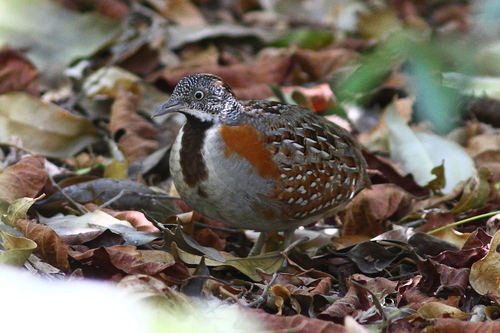
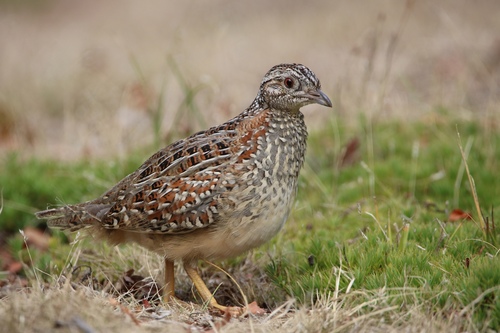
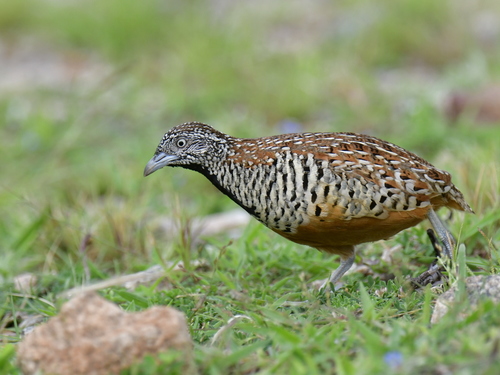
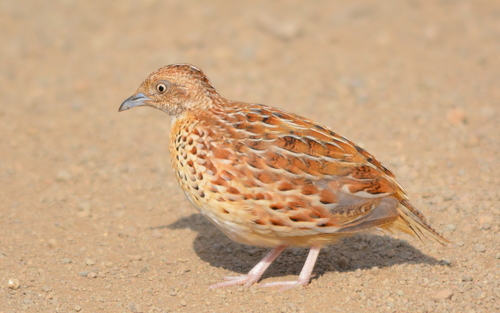
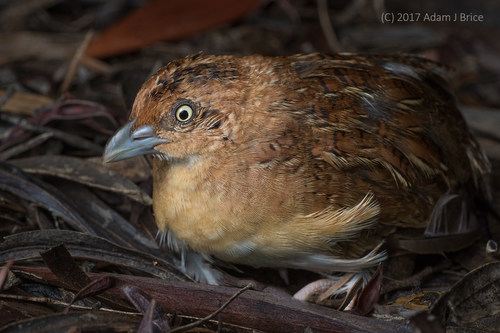
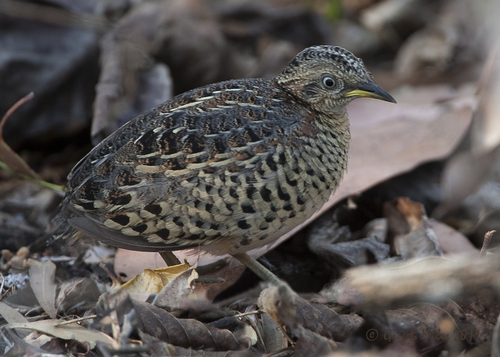
The red-backed buttonquail, scientifically named Turnix maculosus (Temminck, 1815), is a small, stocky bird with round-tipped wings and a short tail.
Size and Sexual Dimorphism in Mass
Its total length ranges between 12 and 16 cm (4.7 and 6.3 in). Females are larger than males: females weigh 32 to 51 g (1.1 and 1.8 oz), while males weigh 23 to 39 g (0.8 to 1.4 oz).
Northern Subspecies Soft Part Features
The northern Australian subspecies T. m. melanotus has a pale yellow beak, yellowish irises, and yellowish legs and feet.
Head and Neck Markings
The front and top of its head are blackish with grey scalloped markings; the sides of the head, neck, and throat are brownish-buff, with a partial reddish-brown collar.
Upper Body and Under-Wing Plumage
Its upper body is slate grey, with narrow bars of reddish-brown and black. Under-wing plumage is pale grey.
Underpart Markings
The lower throat is whitish, darkening to buff on the breast and belly, and the flanks have bold spots and scalloped markings.
Sexual and Juvenile Plumage Differences
The sexes have similar general appearance, but females are more vividly colored, with a brighter yellow beak and a more distinct chestnut collar. Juveniles are much darker in color. Other recognized subspecies have slight differences from this color pattern.
Global Distribution Range
This buttonquail is native to southeastern Asia and Oceania. Its range extends from Indonesia, Papua New Guinea, the Philippines, the Solomon Islands, and East Timor to Australia.
Australian Distribution
In Australia, it occurs in a coastal strip stretching from northeastern Western Australia to Cape York, and southward to northeastern New South Wales.
Common Habitat Types
It mostly lives in rough, tussocky grassland, woodland, and cropland.
Elevation and Precipitation Requirements
It is generally a lowland bird, but the subspecies T. m. giluwensis occurs at elevations over 2,000 m (6,600 ft) in east-central New Guinea. In Australia, it is typically found near water, only occurs in areas that receive at least 400 mm (16 in) of rain in summer, and is only resident year-round in areas with at least 800 mm (31 in) of annual precipitation.
Activity and Social Behaviour
Red-backed buttonquail are most active at dusk and night. They are ground-dwelling, and move either alone, in pairs, or in small groups of up to five individuals.
Anti-Predator and Movement Patterns
When disturbed, they may freeze or run, and rarely fly; when they do take flight, they usually do not travel far. Despite this, some populations are thought to be partially migratory, likely traveling at night, and their movement patterns are not well documented.
Diet Composition
They feed on grass and sedge seeds, other seeds, green plant material, and insects, and likely consume more insect prey than other species in the same genus.
Breeding Timing
Breeding occurs between October and June.
Nest Structure and Placement
The nest is built at the base of a grass tussock, usually among tall grasses in a wet area. It is shaped as a hollow scoop lined with grass, leaves, and bits of dung, and is often covered by a roof woven from nearby growing grasses.
Parental Care and Mating System
After the female lays a clutch of two to four whitish eggs marked with dark speckles, the male takes over incubation and is solely responsible for caring for the young. Females are serially polyandrous, and will seek out another male to repeat the breeding process.