About Turdus viscivorus Linnaeus, 1758
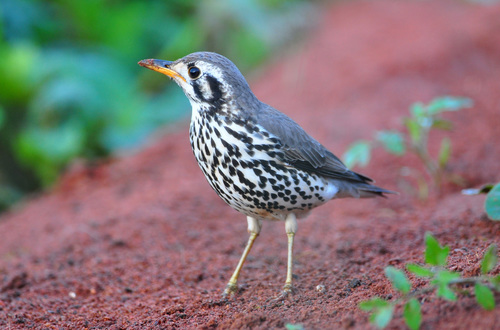
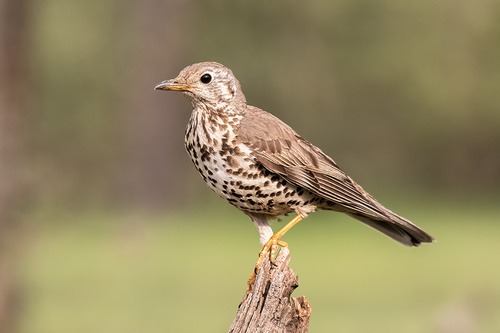
The mistle thrush (Turdus viscivorus Linnaeus, 1758) is the largest thrush native to Europe. The nominate subspecies measures 27–28 cm (11–11 in) long, with a 45 cm (18 in) wingspan, and weighs 93 to 167 g (3.3 to 5.9 oz), with an average weight of around 130 g (4.6 oz). On the ground, it holds a stocky, upright posture. It has pale grey-brown upperparts, greyish-white chin and throat, and yellowish-buff breast and off-white belly marked with round black spots; the spotting grows denser on the lower chest. Its long tail has white tips on the outer feathers, and its underwing coverts are white. Eyes are dark brown, the bill is blackish with a yellowish base on the lower mandible, and legs and feet are yellowish-brown. There are no plumage differences between males and females. Juveniles are similar to adults, but have paler upperparts with creamy teardrop-shaped centres on many feathers, and smaller spots on yellowish underparts. By their first winter, they are very similar to adults, though their underparts usually have a stronger buff tone. The nominate subspecies shows clinal size variation across its range: the darkest individuals occur in western Europe, while the palest are found in Siberia and Turkey. The southeastern subspecies T. v. bonapartei reaches 30 cm (12 in) in length, making it slightly larger than the nominate form; it is paler grey above, whiter below, and has fewer black spots. The southwestern subspecies T. v. deichleri looks similar to T. v. bonapartei, but is closer in size to the nominate T. v. viscivorus, and has a more slender bill. Adult mistle thrushes complete a full moult after breeding, starting between late May and the end of June, and finishing by early October. Juvenile birds undergo a partial moult that replaces their head, body, and covert feathers, completed by October, though the start of the moult depends on when the chicks hatched. The mistle thrush is much larger, paler, and longer-tailed than the sympatric song thrush. In the western Himalayas, it could be confused with the plain-backed thrush and long-tailed thrush. While similar to the mistle thrush, the plain-backed thrush lacks obvious wing bars, is more rufous above, and has barring rather than spotting on its underparts. The long-tailed thrush has olive-toned upperparts, barring on its breast, and two wing bars. Juvenile mistle thrushes look superficially similar to White's thrush, but White's thrush has golden-yellow plumage, scalloped underparts, and a distinctive underwing pattern. The mistle thrush breeds across most of Europe and temperate Asia, though it is not found in the treeless far north, and its range becomes discontinuous in southeast Europe, Turkey, and the Middle East. In these warmer southern areas, it tends to occur in milder uplands and coastal regions. The mistle thrush is a partial migrant: birds from the northern and eastern parts of its range winter in milder areas of Europe and North Africa. Scandinavian and Russian birds begin moving south from mid-September onward, with most wintering in Europe, western Turkey, and the Middle East. Between mid-October and November, large numbers cross the Strait of Gibraltar, and others pass through Cyprus, but there is almost no migration across the North Sea. Breeding birds in the British Isles and north-west Europe are resident or move only short distances. In the Himalayas, the breeding population moves to nearby lower-altitude sites in winter. Return migration mostly starts in late March, though it can begin a month earlier in the Middle East, and northern breeders may not arrive back on their territories until late April or early May. Migration may happen during the day or night, and typically involves individual birds or small groups. Vagrant mistle thrushes have been recorded in the Azores, China, Crete, Faroe Islands, Iceland, Japan, Oman, Saudi Arabia, Sikkim, and the United Arab Emirates. In winter 2017/2018, the first record of a mistle thrush in North America came from Miramichi, New Brunswick; the bird was first found on 9 December 2017 and remained there until 24 March 2018. The mistle thrush lives in a wide range of tree-containing habitats, including forests, plantations, hedges, and town parks. In the southern and eastern parts of its range, it inhabits upland coniferous woodland, and its range extends above the main tree line where dwarf juniper grows. Breeding occurs at up to 600 m (2,000 ft) in the mountains of North Africa, and occasionally as high as 1,700 m (5,600 ft). In the highlands of Europe, its preferred altitude is 800–1,800 m (2,600–5,900 ft). More open habitats such as agricultural land, moors, and grassy hills are widely used during winter or migration. There is evidence that this species has shifted its natural habitat in at least parts of its range. In Germany and other parts of central Europe, it was only found in coniferous forest until the mid-1920s, when its range expanded rapidly: first into farmland, then into suburbs and urban parks. The causes of this expansion are unclear. In areas of intensive farming such as eastern England, the species has largely abandoned arable land in favour of built-up areas, which offer a greater variety of green habitats.