About Turdus unicolor Tickell, 1833
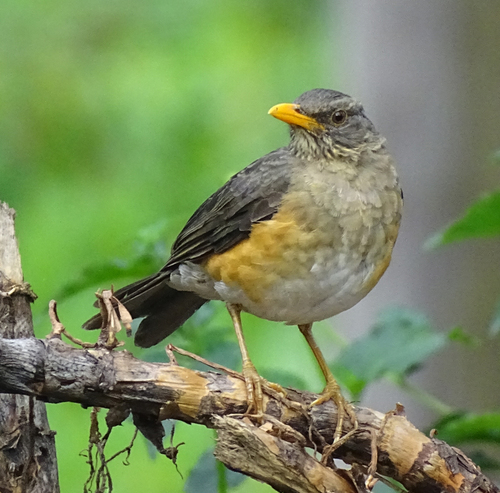
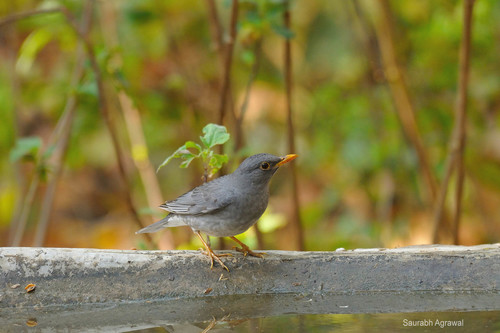
This species is a small thrush, measuring 21–25 cm (8.3–9.8 in) in length and weighing 57–75 g (2.0–2.6 oz). It is similar in size to the redwing or eyebrowed thrush, and distinctly smaller than the Indian blackbird. Males have uniform blue-grey upperparts, with a whitish belly and vent. Females and young birds have browner upperparts. Adults have yellow beaks and legs, which may be darker in juvenile individuals. This thrush has a yellow eye-ring that is thinner and fainter than the eye-ring of the Indian blackbird. It breeds at middle altitudes between 1,200–2,700 m (3,940–8,860 ft), and rarely up to 3,000 m (9,840 ft), in the Himalayas. Its breeding range extends from extreme northeastern Afghanistan east through northern Pakistan, northwestern India and Nepal to Sikkim and western Bhutan. It migrates south and to lower altitudes in Pakistan, India, Nepal and Bangladesh during the winter. There is one confirmed extralimital record of this species: one individual was observed on Heligoland in Germany, on 15 October 1932. This is one of the most unusual known cases of vagrancy for the species. Its breeding habitat consists of broadleaf or mixed forest with clearings, and it also occupies human-altered habitats such as orchards and large gardens, where it will feed on lawns. Winter habitats for the species are similar to breeding habitats. In behaviour and ecology, Tickell's thrush builds nests from April to June, using mostly dry grass.