About Turdus rufopalliatus Lafresnaye, 1840
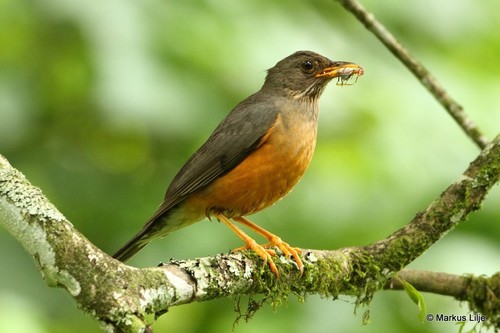
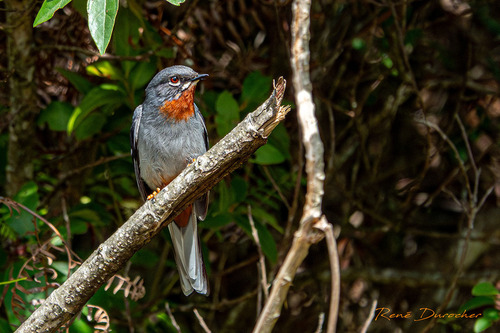
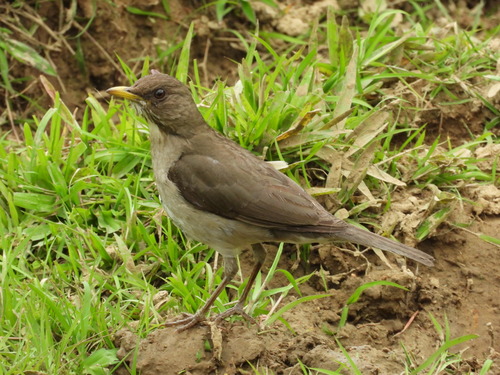
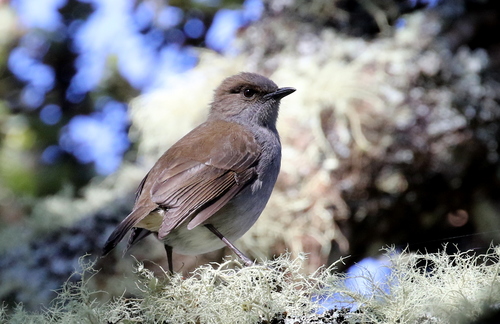
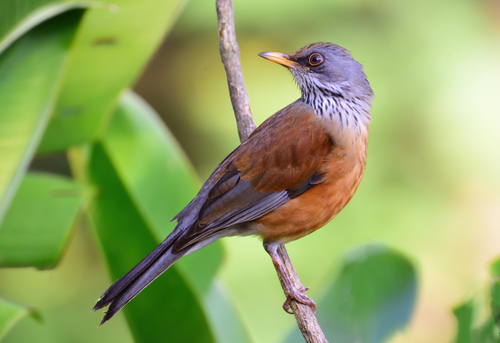
This bird species, Turdus rufopalliatus Lafresnaye, 1840, is also known as the rufous-backed thrush. In general appearance, it resembles its widespread close relative, the American robin, but is slightly smaller. It measures 21.5–24 cm (8.5–9.4 in) long, with an average wingspan of 39.4 cm (15.5 in) and an average weight of 74 g (2.6 oz). The species gets its name from the rufous or olive-rufous upper back of adult individuals, which contrasts with the grayish color of the head, nape, and rump. The chest and flanks are also rufous, while the belly and undertail coverts are white. The throat is white with heavy black streaks, and both the bill and eye-ring are yellow. Females are typically somewhat duller in color than males. Like juveniles of other Turdus thrushes, juvenile rufous-backed thrushes have spotted underparts; they are browner overall and have pale flecks on their upperparts. The subspecies found on the Islas Tres Marías, and also around San Blas, Nayarit, is sometimes classified as a separate species called Grayson's robin or Grayson's thrush, with the scientific name Turdus graysoni (Ridgway, 1882). This form has a washed-out appearance, with very little rufous tinting. The song of the rufous-backed thrush is slow and warbling, with repeated phrases; an example of a transcribed song phrase is "weedele loo loo freerlii...". Its alarm call is a long, mellow, descending whistle, transcribed as "cheeoo or teeeuu". Other calls of the rufous-backed thrush are similar to those of the American robin, and its flight call is thinner. The rufous-backed thrush lives in dry deciduous forests, including forest edges, and also occurs in human-planted habitats, where it can be found from ground level up to high in the tree canopy. Its main distribution range extends along the coast and in the Río Balsas drainage from southeastern Sonora to the southeastern corner of Oaxaca. Isolated populations found in Mexico City and Oaxaca City are most likely descended from escaped cage birds. A number of vagrant individuals have been recorded in the Mexican-border states of the United States, where they are often found in riparian woods.