About Turdus plebejus Cabanis, 1861
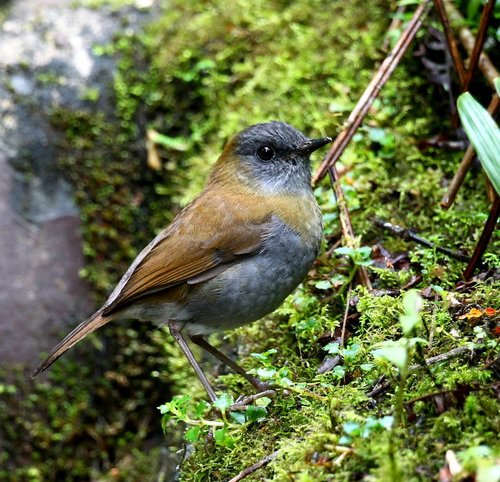
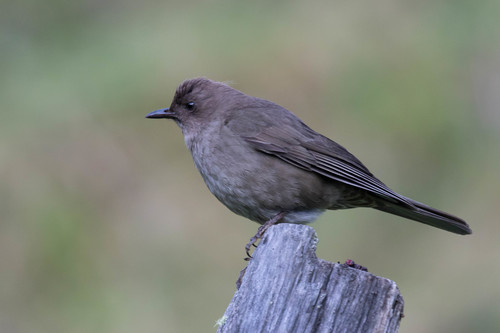
The mountain thrush (Turdus plebejus Cabanis, 1861) measures 23 to 25.5 cm (9.1 to 10 in) in length. Males have an average weight of about 81 g (2.9 oz), while females average about 92 g (3.2 oz). Both sexes have identical plumage. Adults of the nominate subspecies T. p. plebejus have mostly olivaceous brown upperparts, with a browner head and more olivaceous rump and uppertail coverts. Their throat is pale brown with faint sepia brown streaks, and their underparts are light brown, palest at the center of the belly. This subspecies has a dark brown iris, a blackish brown bill, and brown to dark brown legs and feet. Juveniles have cinnamon flecks on their olivaceous brown upperparts, and cinnamon brown throat and underparts with darker mottling. Subspecies T. p. differens is larger than the nominate subspecies, and is much browner overall. Its underparts tend toward raw umber, and its unstreaked throat matches the color of its underparts. T. p. rafaelensis is smaller than the other two subspecies. Its plumage is intermediate between the two, with medium brown upperparts, a slightly streaked throat, and underparts with no umber. Both T. p. differens and T. p. rafaelensis have brownish bills. The sooty thrush (T. nigrescens), a superficially similar relative that shares part of the mountain thrush's range, is blacker and has an orange bill, eye ring, and legs. The mountain thrush has a disjunct distribution, with each subspecies occupying a separate range. The northernmost subspecies is T. p. differens, which occurs from the southern Mexican states of Oaxaca and Chiapas well into the southern half of Guatemala. T. p. rafaelensis is found from extreme eastern Guatemala across much of Honduras into north-central Nicaragua, and also in isolated locations in El Salvador. The nominate subspecies occurs in Costa Rica's Cordillera de Guanacaste, Cordillera Central, and Cordillera de Talamanca; the last of these ranges extends into far western Panama's Chiriquí and Bocas del Toro provinces. The mountain thrush inhabits the interior and edges of primary and secondary montane evergreen and pine-oak forests in the subtropical and lower temperate zones. It favors forests with abundant mosses and epiphytes, and also occurs in moss-covered trees in pastures and gardens. During the non-breeding season, it can be found in open groves of fruit-bearing trees. Overall, it occurs at elevations between 900 and 3,500 m (3,000 and 11,500 ft). In Guatemala and Honduras, it lives between 1,300 and 3,200 m (4,300 and 10,500 ft), and in Costa Rica it is mostly found above 1,200 m (3,900 ft).