About Turdus philomelos C.L.Brehm, 1831
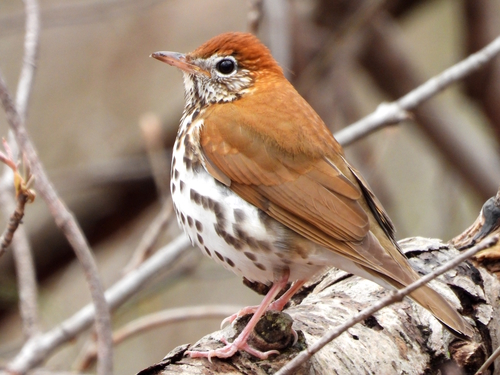
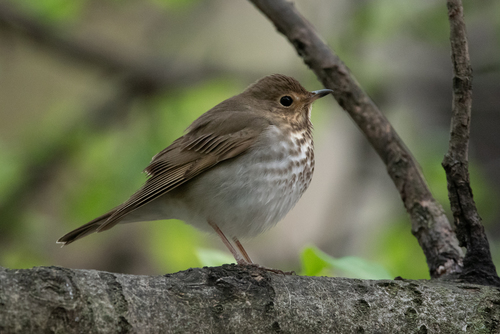
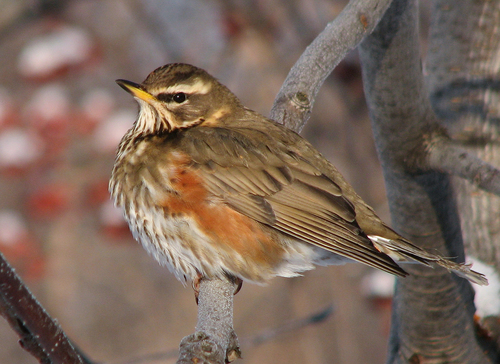
This is the song thrush, with the scientific name Turdus philomelos C.L.Brehm, 1831. The nominate subspecies T. p. philomelos is 20 to 23.5 centimetres (7+3⁄4 to 9+1⁄4 inches) long and weighs 50 to 107 grams (1+3⁄4 to 3+3⁄4 ounces). The sexes are similar in appearance, with plain brown backs, neatly black-spotted cream or yellow-buff underparts that become paler on the belly, a warm yellow underwing, a yellowish bill, and pink legs and feet. Across its breeding range from Sweden to Siberia, the species' upperparts become colder in tone moving from west to east. Juveniles resemble adults, but have buff or orange streaks on the back and wing coverts. The most similar European thrush species is the redwing (T. iliacus), which has a strong white supercilium, red flanks, and shows a red underwing in flight. The mistle thrush (T. viscivorus) is much larger and has white tail corners. The Chinese thrush (T. mupinensis) is more similar in plumage, but has black face markings and does not share an overlapping range with the song thrush. The song thrush has a short, sharp tsip call; this is replaced by a thin high seep during migration, which is similar to the redwing's call but shorter. The alarm call is a chook-chook that becomes shorter and more strident as danger increases. Males sing from elevated perches such as trees, rooftops, or other high spots, producing a loud clear run of musical phrases repeated two to four times, interspersed with grating notes and mimicry. Singing occurs mainly from February to June for the Outer Hebridean race, and from November to July for more widespread subspecies. For its weight, this species has one of the loudest bird calls. An individual male may have a repertoire of more than 100 phrases, many copied from its parents and neighbouring birds. Mimicry can include imitating human-made technology like telephones, and song thrushes will also repeat the calls of captive birds, including exotic species such as the white-faced whistling duck.
Distribution and habitat The song thrush breeds in most of Europe (though not in most of Iberia, lowland Italy or southern Greece), and across Ukraine and Russia almost to Lake Baikal. It reaches 75°N in Norway, but only to about 60°N in Siberia. Birds from Scandinavia, Eastern Europe and Russia winter around the Mediterranean, North Africa and the Middle East, while only some of the birds in the milder western part of the breeding range leave their breeding areas. The song thrush is a rare vagrant that has been sighted in North America, with records from Quebec in Canada, Greenland, and Alaska, California, and Washington in the United States. It has also been sighted in various Atlantic islands and West Africa, and there is one record from Colombia in South America. In Great Britain, song thrushes are commonly found where there are trees and bushes, including parks, gardens, coniferous and deciduous woodland, and hedgerows. The subspecies T. p. clarkei was introduced to New Zealand and Australia by acclimatisation societies between 1860 and 1880, apparently for purely sentimental reasons. In New Zealand, where it was introduced on both main islands, the song thrush quickly established itself and spread to surrounding islands such as the Kermadecs, Chatham and Auckland Islands. Although it is common and widespread in New Zealand, in Australia only a small population survives around Melbourne. In New Zealand, introduced song thrushes appear to have a limited detrimental effect on some invertebrates through predation, and the song thrush also damages commercial fruit crops in that country. As an introduced species, it has no legal protection in New Zealand, and can be killed at any time. The song thrush typically nests in forest with good undergrowth and nearby more open areas, and in western Europe it also uses gardens and parks. It breeds up to the tree-line, reaching 2,200 metres (7,200 feet) in Switzerland. The island subspecies T. p. hebridensis breeds in more open country, including heathland, and in the east of the song thrush's Eurasian range, the nominate subspecies is restricted to the edge of dense conifer forests. In intensively farmed areas where agricultural practices have made cropped land unsuitable, gardens are an important breeding habitat. In one English study, only 3.5% of territories were found in farmland, while gardens held 71.5% of the territories, even though gardens made up only 2% of the total area. The remaining nests were in woodlands, which made up 1% of total area. Winter habitat is similar to breeding habitat, except that high ground and other exposed localities are avoided; however, the island subspecies T. p. hebridensis will frequent the seashore in winter.
Behaviour and ecology The song thrush is not usually gregarious, although several birds may roost together in winter or be loosely associated in suitable feeding habitats, sometimes alongside other thrushes such as the blackbird, fieldfare, redwing and dark-throated thrush. Unlike the more nomadic fieldfare and redwing, the song thrush tends to return regularly to the same wintering areas. This is a monogamous territorial species. In areas where it is fully migratory, the male re-establishes its breeding territory and starts singing as soon as he returns. In the milder areas where some birds stay year round, the resident male remains in his breeding territory, singing intermittently, but the female may establish a separate individual wintering range until pair formation begins in the early spring. During migration, the song thrush travels mainly at night with a strong and direct flight. It flies in loose flocks that cross the sea on a broad front rather than concentrating at short crossings, as occurs in the migration of large soaring birds, and calls frequently to maintain contact. Migration may start as early as late August in the most easterly and northerly parts of the range, but the majority of birds, with shorter distances to cover, head south from September to mid-December. Hard weather may force further movement. Return migration varies between mid-February around the Mediterranean to May in northern Sweden and central Siberia.
As food Humans have trapped song thrushes for food from as far back as 12,000 years ago, and an early reference is found in the Odyssey. Hunting continues today around the Mediterranean, but is not believed to be a major factor in this species' decline in parts of its range. In Spain, this species is normally caught as it migrates through the country, often using birdlime. Birdlime is banned by the European Union, but is still tolerated and permitted in the Valencian Community. In 2003 and 2004 the EU tried, but failed, to stop this practice in the Valencian region.