About Turdus nudigenis Lafresnaye, 1848
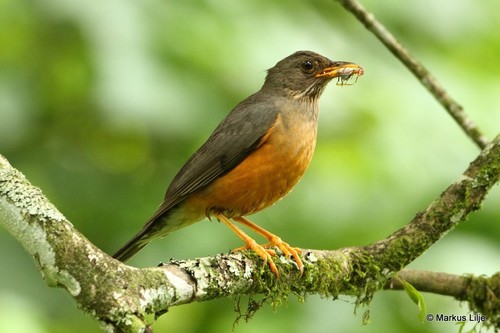
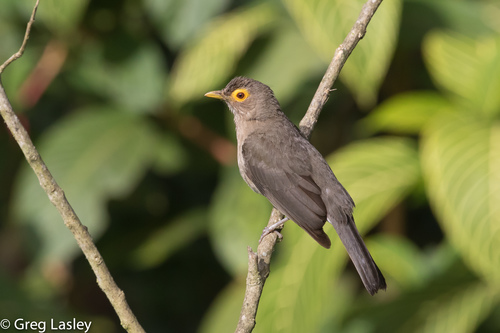
The spectacled thrush, also known as the bare-eyed thrush, has a scientific name of Turdus nudigenis Lafresnaye, 1848. This bird measures 23–24 cm (9.1–9.4 in) in length and weighs approximately 60 g (2.1 oz). Its upperparts are plain olive-brown, while its underparts are paler brown. The throat is off-white with brown streaks, and the lower belly is whitish. It has a prominent yellow eye ring, which is the origin of both its English common name and scientific name. There are two poorly defined subspecies of this thrush, which differ mainly in how dark their plumage is. Male and female spectacled thrushes look similar. Young birds are flecked on their upperparts and spotted on their underparts, and they have a thinner eye ring than adults. The song of the spectacled thrush is a musical warble, slower and lower in pitch than the song of the cocoa thrush (T. fumigatus). It also makes a cat-like queeoow call, and emits a kereel call when it feels uncomfortable. This large thrush lives in open woodland, forest clearings and cultivation. The bare-eyed thrush feeds mainly on or near the ground, and its diet consists of fruit, berries, plus some insects and earthworms. It is generally a shy species, but it is much tamer on Trinidad and Tobago, where it will visit feeders and take food from tables. Its nest is a bulky, lined cup made of twigs, built low in a tree. The clutch contains two to three deep-blue eggs with reddish blotches, which are incubated solely by the female.