About Turdus nigrescens Cabanis, 1861
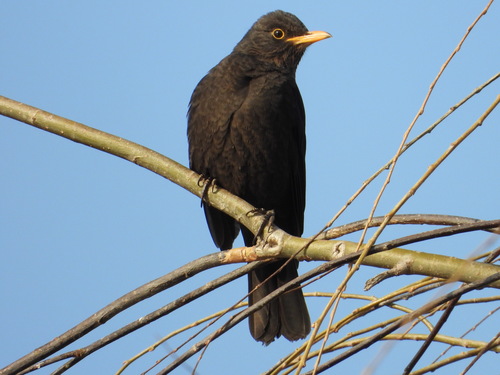
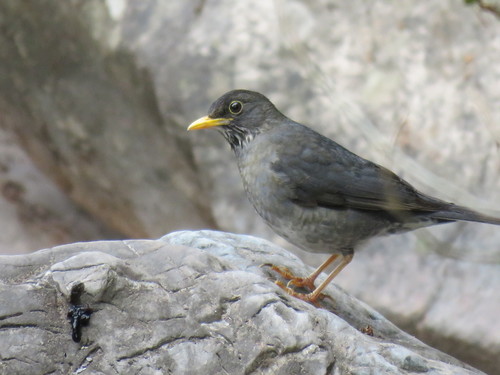
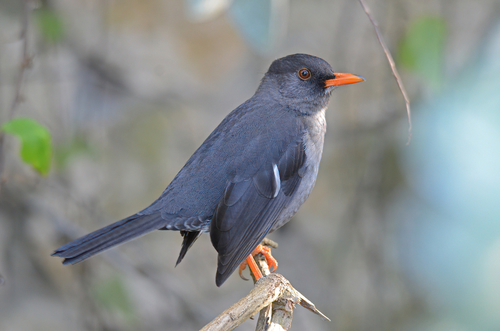
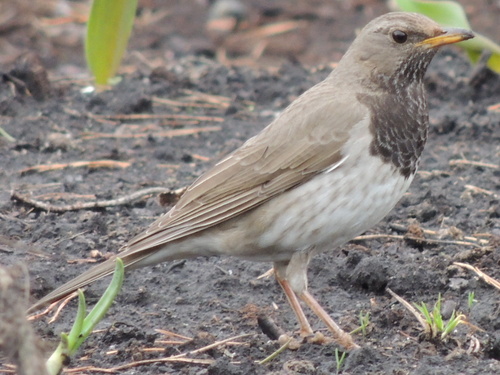
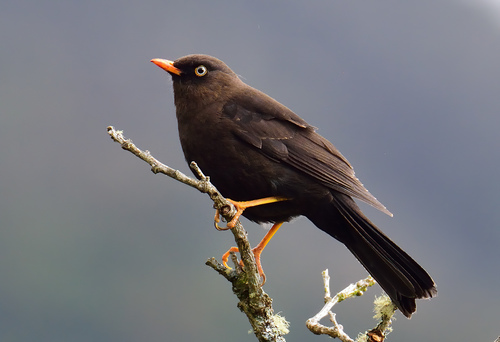
This species, commonly called the sooty thrush, has the scientific name Turdus nigrescens Cabanis, 1861. Adult sooty thrushes measure 24 to 25.5 cm (9.4 to 10 inches) in length, and weigh approximately 96 g (3.4 oz). The species displays sexual dimorphism. Adult males have mostly brownish-black heads and bodies, with sooty black lores and an orange eye-ring. Their wings and tail are also sooty black. Adult females have a similar overall pattern to males, but are browner across their entire body, and sometimes have dark streaks on their throat. Both adult males and females have a white iris, a yellow-orange bill, and orange legs and feet. Juvenile sooty thrushes have dark brown upperparts marked with buff streaks, and buff underparts marked with dark brown spots. They have a white chin, a pale iris, and brownish yellow bills, legs, and feet. The mountain thrush (T. plebejus) looks superficially similar to the sooty thrush and shares its range, but the mountain thrush is uniformly brown with dark bare body parts. The sooty thrush also resembles the slaty-backed nightingale-thrush (Catharus fuscater), but the two species do not have overlapping ranges. The sooty thrush has a disjunct distribution. It is found in Costa Rica's Cordillera Central and Cordillera de Talamanca; the range in Cordillera de Talamanca extends into the far western Panamanian province of Chiriquí. In the Cordillera Central, the species occurs on volcanoes that are separated from each other by low passes, and a major valley separates the Cordillera Central populations from those in the Cordillera de Talamanca. The sooty thrush inhabits edges of montane evergreen forest, semi-humid to humid montane scrublands, and second-growth scrublands located in the subtropical and temperate zones. Its scrubby habitat includes páramo, bogs, and pastures. It occurs at elevations ranging from 2,150 to 3,500 m (7,100 to 11,500 ft), and is most common at elevations above 2,400 m (7,900 ft).