About Turdus merula Linnaeus, 1758
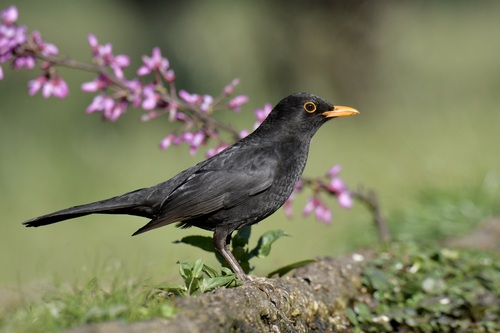
The nominate subspecies of the common blackbird, Turdus merula merula, measures 23.5–29 cm (9.3–11.4 in) in length, has a long tail, and weighs 80–125 g (2.8–4.4 oz). Adult males have glossy black plumage, blackish-brown legs, a yellow eye-ring, and an orange-yellow bill that darkens slightly in winter. Adult females are sooty-brown, with a dull yellowish-brown bill, a brownish-white throat, and faint mottling on the breast. Juveniles resemble females but have pale spots on their upperparts; very young juveniles also have a speckled breast. Young birds vary in brown shade, with darker birds likely being male. First-year males look similar to adult males but have a dark bill, a less distinct eye ring, and brown folded wings rather than the black body plumage of adults.
Common blackbirds breed in temperate Eurasia, North Africa, the Canary Islands, and South Asia, and have been introduced to Australia and New Zealand. Populations in the southern and western parts of their range are non-migratory, while birds from northern areas migrate south as far as northern Africa and tropical Asia for winter. Urban males are more likely to overwinter in cooler regions than rural males, an adaptation enabled by warmer urban microclimates and more abundant food that lets them establish territories and begin breeding earlier in the year. Recoveries of blackbirds ringed on the Isle of May show that these birds commonly migrate from southern Norway (or as far north as Trondheim) to Scotland, with some continuing on to Ireland. Birds ringed in Scotland have also been recovered in England, Belgium, the Netherlands, Denmark, and Sweden. Female blackbirds in Scotland and northern England are more likely to migrate to Ireland for winter than males of the species.
This species is common across most of its range in woodland, and prefers deciduous trees with dense undergrowth. Gardens, however, provide the best breeding habitat, supporting up to 7.3 pairs per hectare (nearly three pairs per acre); woodland typically supports around one tenth of that density, while open and heavily built-up areas support even lower densities. In higher altitude areas, common blackbirds are often replaced by the related ring ouzel. Common blackbirds also live in parks, gardens, and hedgerows. They occur at elevations up to 1,000 m (3,300 ft) in Europe, up to 2,300 m (7,500 ft) in North Africa, and between 900–1,820 m (2,950–5,970 ft) in peninsular India and Sri Lanka. The large Himalayan subspecies T. m. maximus occurs much higher, breeding at 3,200–4,800 m (10,500–15,700 ft) and remaining above 2,100 m (6,900 ft) even in winter. This widespread species has been recorded as a vagrant in many locations outside its native Eurasian range, but most records from North America are thought to be of escaped captive birds, such as the individual recorded in Quebec in 1971. A 1994 record from Bonavista, Newfoundland, has been accepted as that of a genuine wild individual, so the species is now included on the North American bird list.
Male common blackbirds defend their breeding territories by chasing away other males or performing a "bow and run" threat display, which consists of a short run followed by the bird raising its head and bowing while dipping its tail at the same time. Fights between males are usually brief, and the intruder is quickly chased away. Female blackbirds are also aggressive in spring when competing with other females for quality nesting territory; though fights are less frequent, they tend to be more violent. Bill appearance plays an important role in common blackbird social interactions. Territorial defending males respond more aggressively to bird models with orange bills than to those with yellow bills, and respond least aggressively to the brown bill colour typical of first-year males. Females, by contrast, do not respond differently to bill colour and instead react more strongly to shinier bills. As long as food is available in winter, both males and females will remain on their territory year-round, though they occupy separate areas within it. Migrating blackbirds are more social, travelling in small flocks and feeding in loose groups on their wintering grounds. The flight of migrating common blackbirds is made up of bursts of rapid wing beats mixed with level or diving movement. This differs from both the species' normal fast, agile flight, and the dipping flight pattern of larger thrushes.