About Turdus iliacus Linnaeus, 1758
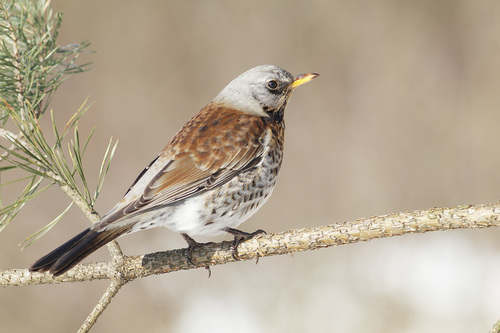
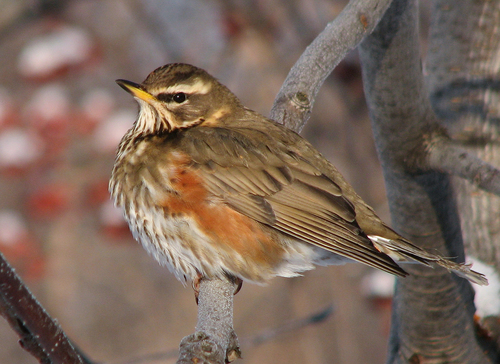
This species of thrush, Turdus iliacus, measures 20–24 cm in length, has a wingspan of 33–34.5 cm, and weighs 50–75 g. Males and females have similar appearance: plain brown backs, white underparts marked with dark brown spots. Its most distinct identifying features are red flanks and underwing, plus a creamy white stripe above the eye. Adult birds moult between June and September, meaning some begin replacing their flight feathers while they are still feeding young. This thrush, commonly called the redwing, breeds in northern regions of Europe and the Palearctic. Its breeding range extends from Iceland south to northernmost Scotland, and east through Scandinavia, the Baltic States, northern Poland, Belarus, and most of Russia to approximately 165°E in Chukotka Autonomous Okrug. In recent years it has expanded its breeding range slightly: in eastern Europe it now breeds as far south as northern Ukraine, and it colonised the Qaqortoq area of southern Greenland in 1990–1991. In higher altitude areas, this species is often replaced by the related ring ouzel. The redwing thrush is migratory, and winters in western, central and southern Europe, north-west Africa, and south-west Asia as far east as northern Iran. Some birds in the western parts of its breeding range, particularly south-western Norway, may be resident and do not migrate at all. Birds breeding in the far east of the range migrate at least 6,500–7,000 km to reach their wintering grounds. There are multiple records of vagrant redwing thrushes on the north-east coast of North America, plus two confirmed sightings on the north-west coast: one in Washington in 2005, and one in Seward, Alaska in November 2011. During migration and winter, redwing thrushes often gather in loose flocks. Flock sizes range from 10 to at least 200 birds. They frequently feed alongside fieldfares, common blackbirds, and starlings. They may also feed with mistle thrushes, song thrushes, and ring ouzels. Unlike the song thrush, the more nomadic redwing does not usually return regularly to the same wintering areas. Migration takes place between autumn and early winter, and redwings often travel at night. They frequently produce a long-distance "Tseep" contact call.