About Turdus fulviventris P.L.Sclater, 1858
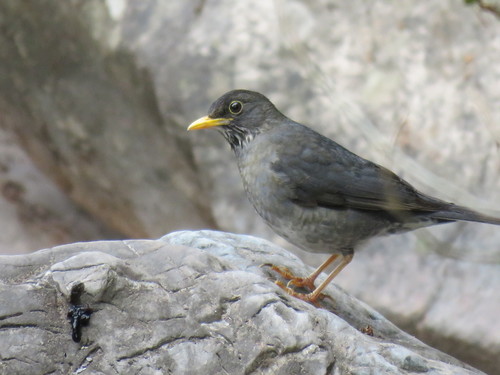
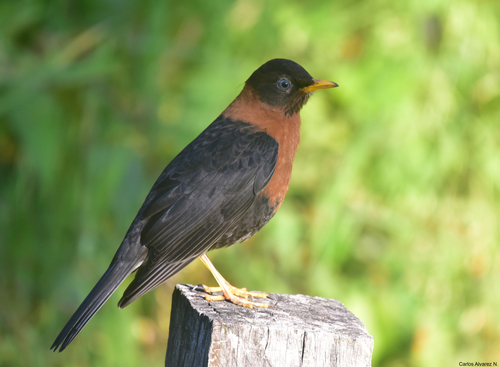
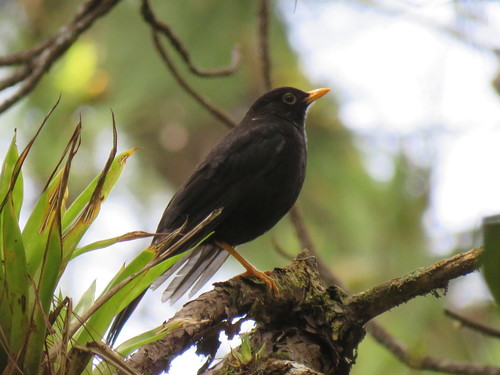
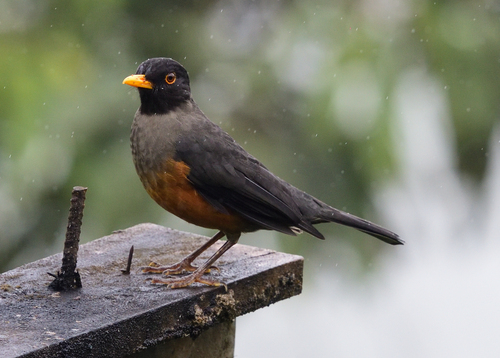
The chestnut-bellied thrush (Turdus fulviventris P.L.Sclater, 1858) reaches an adult length of about 25 cm (10 in). Adult males have a black head, a black throat marked with some white streaks, a dark grey back, and dusky wings and tail. Their upper breast is pale grey, while the lower breast and belly are rufous. The beak is yellow, the narrow eye ring is orange, and the legs are dull yellow. Females have a similar appearance but are noticeably duller in coloration. This is the only rufous-bellied species of the Turdus genus that occurs in the northern Andes. The species' song is not frequently heard; it is made up of a series of disconnected phrases, with occasional buzzes and short trills between phrases.
The chestnut-bellied thrush is native to northwestern South America, with a range covering western Venezuela, western Colombia, Ecuador, northern Peru, and northwestern Bolivia. It inhabits woodland, as well as the canopy and edges of montane forests, at altitudes between 1,400 and 2,600 m (4,600 and 8,500 ft).
Ecologically, this thrush is most often found alone, though it may also be seen in pairs, and it does not usually join mixed-species foraging flocks. Males may sing from high perches in the forest canopy, and both sexes forage among twigs and branches. It sometimes descends to ground level, especially alongside roads and trails, where it turns over leaf litter to search for invertebrate prey, and may stay in one area for an extended period of time.