About Turdus flavipes Vieillot, 1818
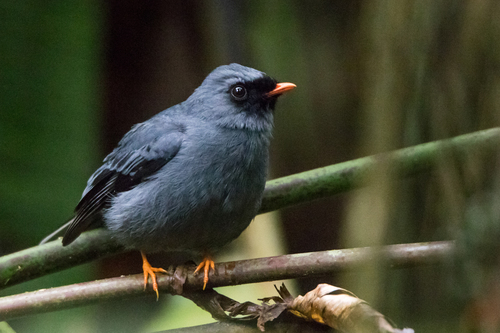
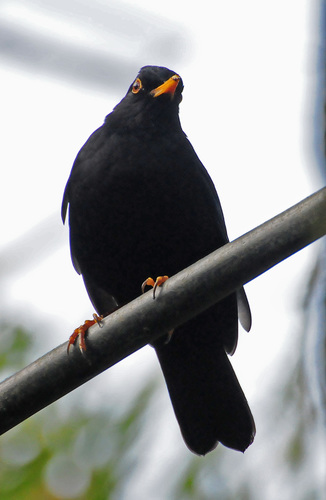
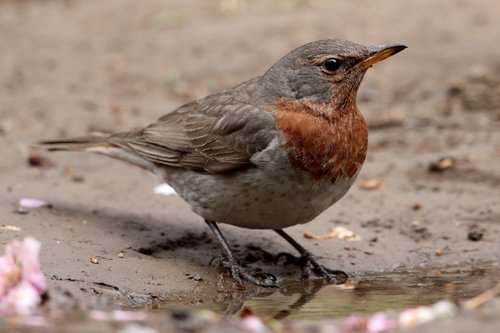
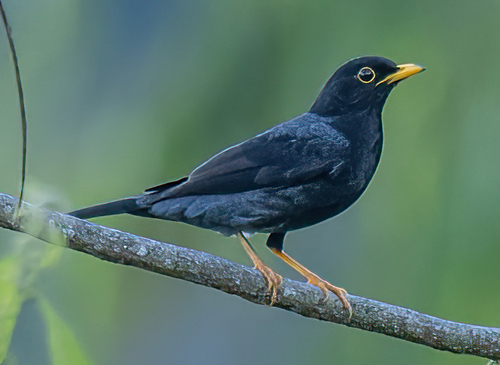
This species of thrush, Turdus flavipes Vieillot, 1818, measures 22–23 cm (8.7–9.1 in) in length and weighs 55–70 g (1.9–2.5 oz). Both males and females have yellow legs and a yellow eye-ring. Adult males have a yellow bill; their plumage is typically black, with a slate-grey back and lower underparts. The shade of these grey areas varies between individuals, and one of the five recognized subspecies, P. f. xanthoscelus found on Tobago, has an entirely black male, which resembles the male Eurasian blackbird (Turdus merula). Adult females have a dull-colored bill, warm brown upperparts, and paler underparts. Juvenile males are brownish with black wings and tail. Juvenile females resemble adult females, but are duller, with orange flecks on their upperparts and dark brown spotting and barring on their underparts. The male’s song consists of musical phrases transcribed as sreep, sreee, sree, sreee, and is somewhat similar to the song of the Eurasian blackbird. It may sometimes include imitations of other birds’ songs. The species’ typical call is a sharp srip, and a distinctive seeet call is given when the bird is alarmed. Turdus flavipes has a strongly disjunct distribution. One population breeds in northern Colombia, Venezuela, the far north of Brazil, Trinidad, Tobago, and Margarita, as well as parts of the Pakaraima Mountains in western Guyana, including apparently Mount Roraima. A second population lives in eastern Brazil, eastern Paraguay, and the far northeast of Argentina. The Argentine subpopulation is partially migratory: birds in the northern portion of this area are resident year-round, while the southernmost breeders move further north for the Austral winter. Some northern South American populations also make local movements, though these movements are not well understood. The habitat of this small thrush includes rainforest, secondary woodland, and overgrown plantations. It is mainly found in highland areas up to 2,000 m (6,600 ft) above sea level, but occurs locally at elevations as low as near sea level. The yellow-legged thrush forages for food mostly in trees and bushes, and only rarely feeds on the ground. It eats mainly fruits and berries, such as those from plants in the Melastomataceae family. It rarely or never joins mixed-species feeding flocks, because its habit of staying in tree tops means joining these conspicuous groups is rarely useful. It builds a shallow cup-shaped nest lined with material, made of twigs, placed on a bank or among rocks. It lays clutches of two or three green or blue eggs marked with reddish blotches. The species is fairly common across most of its range, so it is listed as Least Concern by the IUCN. It is a shy species, and the female in particular is difficult to observe, as she does not sing and has cryptic camouflaged coloration.