About Turdus eunomus Temminck, 1831
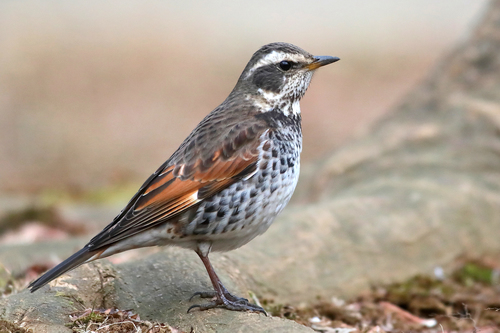
The dusky thrush (Turdus eunomus) is a member of the thrush family. It breeds from central Siberia eastwards to Kamchatka, and winters in Korea, Japan, South China, and Myanmar. It is closely related to Naumann's thrush (T. naumanni), which breeds further to the south; the two species have often been considered conspecific. Its scientific name derives from the Latin word Turdus, meaning "thrush", and the Ancient Greek word eunomos, meaning "orderly". This species breeds in open woodland areas. Unlike Naumann's thrush, the dusky thrush is more tolerant of mountainous and tundra-edge habitats. It is a strongly migratory species, wintering in south to southeast Asia, principally in China and neighboring countries. It is a rare vagrant to western Europe. In December 2016, a sighting of one individual in Derbyshire, United Kingdom, drew hundreds of birdwatchers to observe it. It nests in trees, building an untidy but neatly lined nest where it lays 3 to 5 eggs. Migrating and wintering individuals often form small flocks. It is omnivorous, and eats a wide range of insects (especially mosquitoes), earthworms, and berries. This is a medium-sized but stocky thrush, similar in structure to a small fieldfare. Its underwing is reddish brown, and it has a pale supercilium. The dusky thrush has a dark brown back and rump; its face, breast, and flank spots are black, while its belly and undertail are white. By comparison, Naumann's thrush has a paler brown back and head; its face, breast, flank spots, and rump are reddish, and its belly and undertail are white. Females are fairly similar in appearance to males, but immature individuals have weaker body patterning. The male dusky thrush has a simple fluted or whistling song, similar to the song of the redwing. There are suggestions that the songs of the dusky thrush and Naumann's thrush are different.