About Turdus chiguanco Orbigny & Lafresnaye, 1837
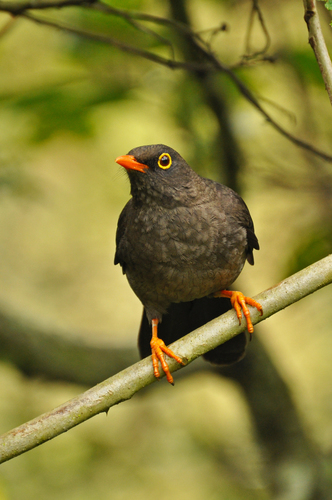
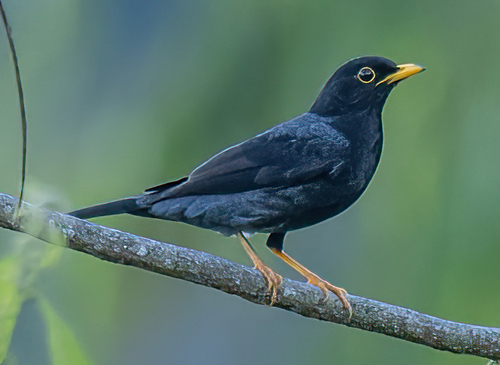
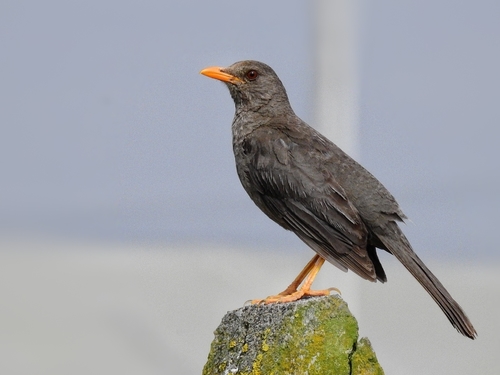
The Chiguanco thrush (Turdus chiguanco Orbigny & Lafresnaye, 1837) is 25 to 30 cm (9.8 to 12 in) long and weighs 75 to 120 g (2.6 to 4.2 oz). Adults of both sexes of the nominate subspecies T. c. chiguanco have uniformly olive gray-brown heads, upperparts, wings, and tails. Their underparts are slightly paler than their upperparts. This subspecies has a red to chestnut iris, a yellow bill, and yellow legs and feet. Juvenile Chiguanco thrushes are dull grayish olive, with browner wings and tails than adults. They have pale spots on their wing coverts, pale buff streaks on their back, and buff to brown spots and streaks across their underparts. The subspecies T. c. conradi is larger and paler than the nominate subspecies, but cannot be distinguished from the nominate when observed in the field. Adult males of the subspecies T. c. anthracinus are almost entirely sooty black, with slightly paler throats and underparts. They have a yellow eye-ring and orange-yellow bill, legs, and feet. Adult females of this subspecies are overall dark brown or grayish brown, with little visible difference between their upperparts and underparts. Their eye-ring, bill, legs, and feet are paler than the same features on adult males of this subspecies. Juvenile T. c. anthracinus are warm brown, darker on their upperparts than on their underparts, with chestnut spots on their wing coverts and pale spots and streaks on their underparts. The Chiguanco thrush has a disjunct distribution across western South America. The nominate subspecies occurs from Pichincha Province in north-central Ecuador south to central Peru. Subspecies T. c. conradi occurs from coastal Peru east into western Bolivia, and south into extreme northern Chile. Subspecies T. c. anthracinus occurs from central Bolivia and northeastern Chile south to west-central Argentina, and may extend from this range into central Chile. The Chiguanco thrush lives in a variety of dry, somewhat open landscapes. These habitats include agricultural areas with scattered trees, gardens, scrubby deciduous woodland, thickets, montane scrublands, and Polylepis woodlands. Within these landscapes, the species is most often found along watercourses or in irrigated areas. In Ecuador, it mostly occurs at elevations between 1,500 and 3,200 m (4,900 and 10,500 ft). In Peru, it is mostly found above 1,600 m (5,200 ft) on the western Andean slope, but occurs locally as low as sea level. On Peru's eastern Andean slope, it mostly ranges between 2,400 and 4,300 m (7,900 and 14,100 ft), though there are verified records of individuals as low as 1,300 m (4,300 ft). In Bolivia, it mostly occurs between 700 and 3,500 m (2,300 and 11,500 ft), but has been recorded as low as 550 m (1,800 ft).