About Turdus albocinctus Royle, 1840
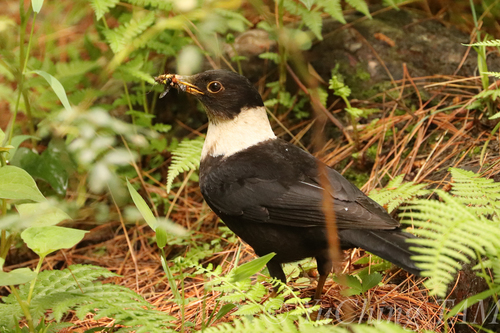
The white-collared blackbird, scientifically named Turdus albocinctus, is a bird species that belongs to the family Turdidae. This species occurs across the Indian subcontinent, with recorded ranges in Bangladesh, Bhutan, India, Myanmar, Nepal and Pakistan. Its natural habitats are subtropical or tropical moist montane forests, and subtropical or tropical high-altitude shrubland. On the Tibetan Plateau, white-collared blackbirds can breed twice per year. The first annual breeding attempt produces small clutches, where only a small number of nestlings successfully fledge, and these fledglings have high body condition. In contrast, the second breeding attempt produces larger clutches that result in more fledged chicks, but these chicks have lower body condition. These observed differences are hypothesized to be caused by variation in parental feeding behaviour and seasonal changes in food availability. Field studies have found that female white-collared blackbirds, but not males, show distinct nest defence behaviours that allow classification into two personality types: bold and shy. Bold females have higher rates of nest success than shy females. When feeding their chicks, adult white-collared blackbirds provide plant material, particularly berries, and invertebrates including arthropods and annelids.