About Turdus albicollis Vieillot, 1818
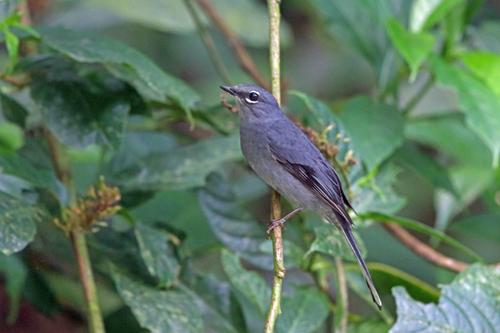
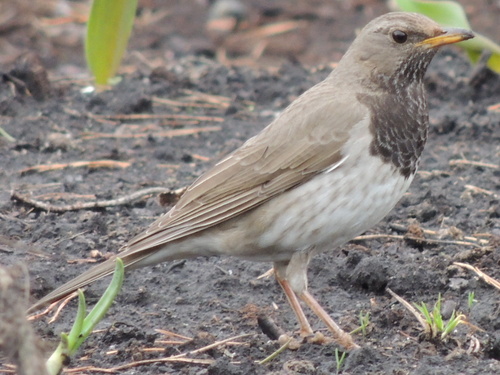
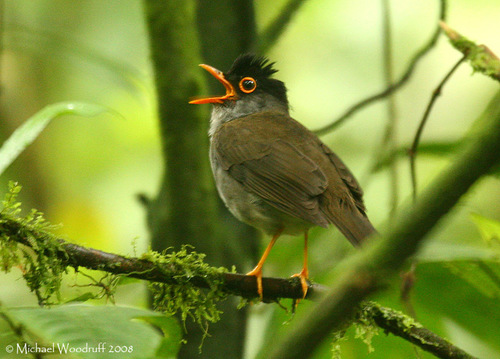
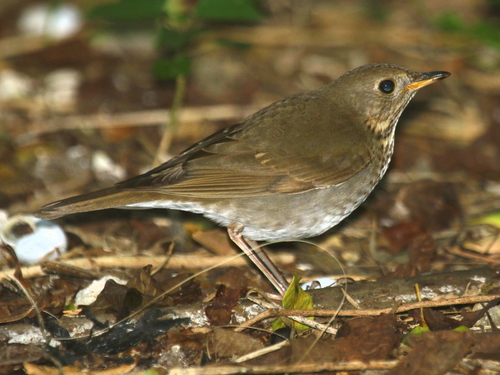
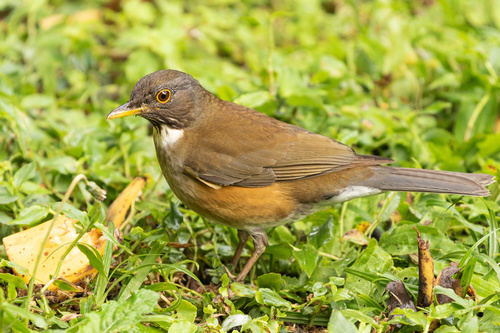
This species of thrush, Turdus albicollis Vieillot, 1818, measures 20+1⁄2–26 cm (8.1–10.2 in) in length and weighs 40–77 g (1.4–2.7 oz). Its upperparts are dark brown, becoming duskier or greyer around the eye area. The throat is white with dense dark streaks, except on its lowermost portion, which creates the appearance of a white crescent below the dark-streaked white throat. This feature gives the species both its English common name and its scientific name. The crissum (the undertail coverts surrounding the cloaca) and central belly are whitish, while the chest is grey and often tinged with brown. Members of the nominate group have noticeable rufous flanks, and a yellow bill with a dusky culmen. In the subspecies crotopezus, the flanks are paler and more tawny, and the entire upper mandible is dusky. Members of the phaeopygos group do not have contrasting rufous or tawny flanks, and their bills are almost entirely dusky. All subspecies have pinkish-brown legs and a reddish or yellow eye-ring. Males and females have similar appearance, but juveniles are duller, with dull orange spotting on the upperparts and brownish spotting on the underparts. The song is relatively musical, often a rather monotonous two-e-o, two-e. The common call is a distinctive wuk, while the alarm call is a rough jjig-wig-wig. The nominate group, which includes the subspecies paraguayensis and crotopezus, occurs in eastern Brazil, far northern Uruguay, eastern Paraguay and far north-eastern Argentina. The phaeopygos group, which includes subspecies phaopygoides, spodiolaemus and contemptus, is mainly found in the Amazon Basin. Populations of this group also extend along the eastern slope of the Andes as far south as north-eastern Argentina, and as far north as western Venezuela, with extensions along the Coastal Range, the region centered around Serranía del Perijá and Sierra Nevada de Santa Marta, and the islands of Trinidad and Tobago. Both groups are mainly associated with humid forest and woodland. The nominate group occurs primarily in the Atlantic Forest, while the phaeopygos group occurs mainly in the Amazon rainforest or humid mountain-adjacent forests and woodlands. This species rarely travels far from vegetative cover.