About Tulipa saxatilis Sieber ex Spreng.
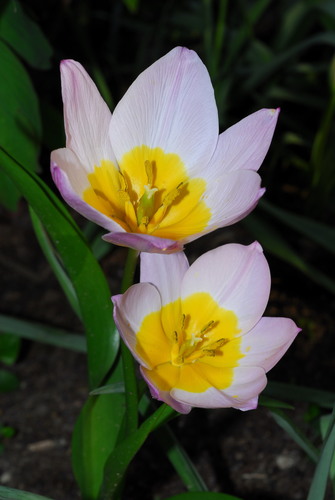
Tulipa saxatilis Sieber ex Spreng. is a perennial herbaceous geophyte (cryptophyte) that grows from bulb resting buds. Its egg-shaped bulbs have a rough outer covering, measuring 2 to 3.5 cm in length and 1.5 to 3 cm in width. Stems of this species can reach a maximum height of 25 centimeters. It produces 2 to 3 flat, narrow lanceolate leaves, which can grow up to 38 centimeters long and 4.5 centimeters wide, and have a distinctly glossy upper surface. Flowers are most often solitary, and only rarely borne in pairs on a single stem. The perianth is bright pink with a sharply defined yellow center, and all petals have pointed tips. The three outer petals measure 38 to 53 mm long and 9 to 18 mm wide; the three inner petals share the same length as the outer petals but are wider. The stamens are hairy at their base, and carry brown to black anthers that are 4.5 to 7 millimeters long. The seed capsule has coarse cross veins in its upper section. Flowering occurs between March and May. This species includes both diploid plants with 2n = 24 chromosomes and triploid plants with 2n = 36 chromosomes. Tulipa saxatilis is native primarily to the Southern Aegean islands. It occurs scattered across limestone areas of Crete, including the islands of Gavdos and Dia, and also grows on Karpathos. It is occasionally found on Rhodes and the Datça peninsula in Western Turkey. Its natural growing habitat is at field edges, on scree slopes, and on rock faces, up to an elevation of 900 meters. This species is cultivated as an ornamental plant, and is reported to be naturalized on the Greek mainland, in Italy, and on the Scilly Isles in the United Kingdom. A well-known common cultivar is 'Lilac Wonder', which is often illustrated and frequently classified as a cultivar of the subspecies T. saxatilis subsp. bakeri A.D.Hall. However, it is generally accepted that the cultivar is derived from T. saxatilis sensu stricto, and it is also grouped as T. saxailis Bakeri Group. 'Lilac Wonder' has been awarded the Royal Horticultural Society's Award of Garden Merit, and it bears pink flowers with yellow coloring at the inner base of the petals.