About Tulipa orphanidea Boiss. ex Heldr.
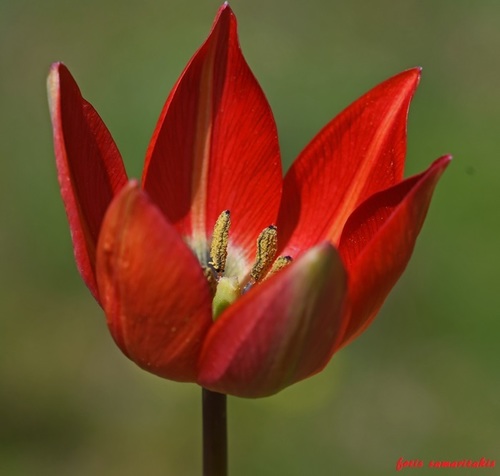
Tulipa orphanidea Boiss. ex Heldr. is a bulbous perennial plant that grows 10 to 20 centimeters tall. Its bulbs measure 20 to 47 millimeters long by 8 to 22 millimeters wide. The stem can be either glabrous or hairy. It produces 2 to 7 green leaves, which grow up to approximately 20 centimeters long by 2 centimeters wide, and often have a red tinge along their edges. Each stem bears 1 to 4 flowers that range from globular to star-shaped. Flowers have copper-red tepals, more rarely yellow or red tepals, arranged in two whorls of three. On the inner surface of each tepal, there is a black basal blotch, which is sometimes yellow instead. Outer tepals are 3 to 6 centimeters long by 1 to 1.8 centimeters wide, while inner tepals are 3 to 6 centimeters long by 1.2 to 2.1 centimeters wide. The plant has six dark olive-colored stamens that are 7 to 12 millimeters long. Its typical chromosome number is 2n = 36, though the numbers 24 or 48 occur rarely. This species is distributed across the southeast Balkans, Bulgaria, Greece, the Aegean Islands, Crete, and western Turkey. It grows in black pine (Pinus nigra) forests, fields, and roadsides, at altitudes up to 1,700 meters, and is restricted to tropical and temperate zones. Tulipa orphanidea blooms from April to May. It has been grown as an ornamental garden plant since 1861. Different natural color forms remain stable in cultivation, and multiple cultivars have been developed and grouped into named Cultivar Groups, such as T. orphanidea Hageri Group and Whittallii Group. One example of a named cultivar is T. orphanidea Hageri Group ‘Splendens’. The Whittallii Group, which has burnt orange inner tepals and a black blotch at the base of each tepal, has been awarded the Royal Horticultural Society's Award of Garden Merit.